October 21, 2026
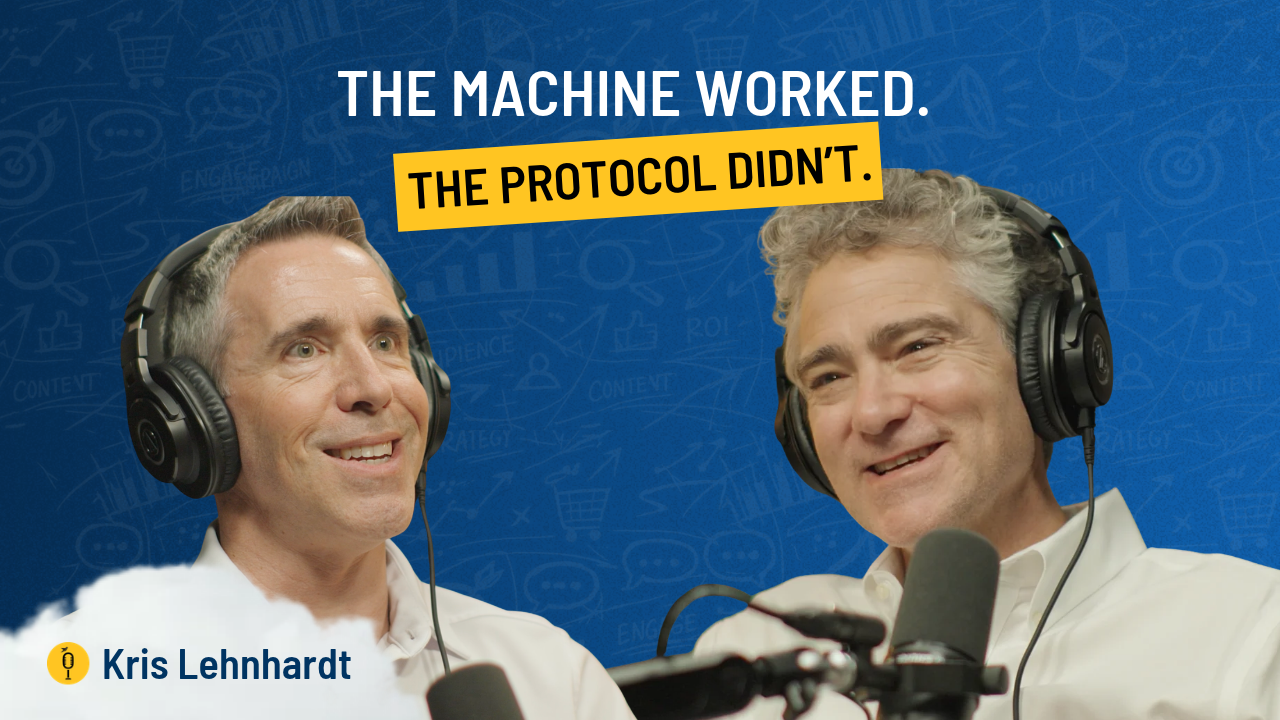
Kris Lehnhardt is the Director of Space Medicine at UTHealth Houston. He spent six years leading the science behind NASA’s medical systems for deep space exploration, and now runs Exploration Health and Medical Systems, helping companies find the space angle in their technology and the Earth angle in NASA’s.
Right now, technology his team helped develop is being tested on the International Space Station: a system that turns drinking water into IV fluid.
Kris and Richard dig into why every hard space problem tends to produce an Earth solution, from the Apollo computer to the heart rate monitor on your wrist. They also cover why NASA’s technology is so hard to access from the outside, and why any space health product needs an Earth market if it wants to make payroll.
They also get into AI as the doctor on board, how to pitch a buyer who swears they don’t have a problem, and where to start if your company wants into the space economy.
If you’ve ever built something brilliant and wondered who else might buy it, this one’s for you.
Richard Byrd
Today we have a very special guest, Kris Lehnhardt. He's here with UTHealth Houston. Kris, welcome to the show.
Kris Lehnhardt
Thank you so much. It's a pleasure to be here.
Richard Byrd
I'm really excited to have you here, because you're at the intersection of two things I'm fascinated with: health and life sciences, and space. And what's cooler than saving lives in space? I can't think of anything cooler. Why don't you tell the audience a little bit about yourself and your background?
Kris Lehnhardt
Sure. First of all, thanks for having me. My background is emergency medicine. Coming up through medical school and all of my training, I was always interested in how you take care of people on their worst day. How do you step in and save people who are injured or sick?
What I loved about emergency medicine was the immediate impact you could have. But I also realized that medicine in the hospital is one thing, and people outside of hospitals need healthcare as well. In particular, people in austere environments need healthcare, and that was really intriguing to me.
I've been a space nerd my entire life, and I couldn't think of a more difficult environment to provide medical care than space. So for a number of years now, my interest has been: How do we provide medical care to people in space? How do we get more people into space than have ever been there before? And how do we develop and advance technologies that take care of people in space and on Earth?
Richard Byrd
I think about remote locations. I'm an avid hiker, and it's occurred to me in the backcountry that I might be somewhere I won't see anybody for two days. What if I sprained my ankle out here? That could be a bad couple of days.
And then I think about the remoteness of space. That's a real frontier, and a hostile environment. You've got radiation and everything else associated with space, which is going to increase the complexity of caring for someone and the possibilities of all the bad things that could happen. What drew you to that complexity?
Kris Lehnhardt
I think the biggest challenge is that we know we can't take a hospital to space, at least not yet. So you have to start thinking in terms of resource costs and the benefits you can have in taking care of people in space.
Fundamentally, I can't take care of everything in space that I can on Earth, so I have to really scope the problem and try to contain it. If you think of every condition a human could possibly get, we can't manage all of those in space, because we just don't have a hospital. But if you break it down into the most likely conditions people could get in space, or the most consequential ones, now you end up with something more manageable as a problem to solve.
One of the things I found interesting was where medicine, engineering, and science all intersect to take care of people in that difficult environment.
Richard Byrd
That's a great way to get your arms around it. What are you seeing at that intersection?
Kris Lehnhardt
It's a challenge right now. My earlier work led me to a job at NASA, and I worked there for seven years for the Exploration Medical Capability element of the NASA Human Research Program. Our job was to create advanced medical systems for space exploration. As the lead scientist for that group, my job was to bring together all the different parties and help them speak the same language.
What I discovered when I arrived at NASA, and what NASA has discovered over time, is that different communities don't speak the same language to each other. When a doctor tried to tell an engineer what their concerns were, they weren't speaking in a language engineers could understand. As a result, the engineers weren't necessarily going to design the systems the way the doctors thought they needed to be designed.
The challenge goes in reverse as well. The engineers were communicating information to the doctors in an engineering language the doctors simply didn't understand. So you end up with groups of people who have a common interest but are speaking past each other. It's very hard for them to generate the solutions they need to solve those common problems if you start from the premise that they're not speaking the same language.
Richard Byrd
That's a great place to start, and I've experienced it myself, not as a doctor, but as a sales and marketing consultant. We work with a lot of engineers and a lot of doctors, and they don't speak sales and marketing language. Working with so many of them, I learned to speak their language and translate mine into theirs. That smoothed things out a lot. There are a lot of assumptions when you're not speaking the same language.
Kris Lehnhardt
Correct.
Richard Byrd
You went through George Washington University, Baylor's Center for Space Medicine, years in NASA's Human Research Program, and now you're at UTHealth. What's the through line? They might seem disconnected, but at least in my brain they make sense.
Kris Lehnhardt
When I started working at George Washington University, one of my interests was extreme environment medicine, and I taught a graduate course there on human health in space. What I discovered teaching that course was that a lot of people who were really interested in human spaceflight didn't understand how difficult spaceflight is for humans, or how many challenges there are to human health and performance in space. To be successful in future space exploration, we have to figure out how to overcome those challenges.
That was the focus of my work at GW, and it's actually what got me noticed by the folks at NASA, who recruited me to move to Houston and design medical systems. So everything comes back to my interest in human spaceflight, how we apply medicine to spaceflight, and how we take technological advances and new capabilities and take care of more and more people in space over time.
Richard Byrd
That's going to be more and more important, especially if we can get people living on the moon in the next five years.
Kris Lehnhardt
It's a very ambitious plan. But the thing people forget is that people have been living in space for twenty-five years consecutively.
It's always fascinating to me when I meet university students and tell them that for their entire life, not all humans have lived on planet Earth. They just don't realize it. To them, the International Space Station is a thing that's been there their entire life. It may seem even more normal to them than to those of us who lived through that whole time.
Living and working on the International Space Station for more than twenty-five years, we have learned a ton about how to take care of people in space. The challenge in the future is that the space station is relatively close to Earth. I know it seems really far away, but we're in Houston right now, and when the ISS passes overhead, it's closer than Dallas. It's only about two hundred and fifty miles above us.
Because of that proximity, the whole idea behind how NASA takes care of people in space is: send only the healthiest people to space. If something really bad happens, someone on Earth will walk you through it. And if we can't walk you through it, we'll bring you home right away.
We did an evacuation from the space station in January for a medical event, and that's the first time that's ever happened. So everything we do in space right now is Earth-dependent. If you want people living and working on the moon, or you want to send people to Mars, we have to start creating new technologies and entirely new ways of doing business in space that are increasingly Earth-independent.
Richard Byrd
The physics are different up there, and that's a big thing to overcome. You don't have as much room on a space station for everything you'd need in a hospital. What are the big limiting factors to practicing medicine in space?
Kris Lehnhardt
We're very fortunate that there's a doctor on the International Space Station today. Interestingly, his name is Anil Menon, and he works with us at UTHealth Houston. He's part of our faculty in our section for space medicine, and he practices emergency medicine with us as well.
But not every space mission has a doctor on board. So the challenge becomes: How do you have the medical knowledge, skills, and abilities in space if you're not going to have a physician on every crew? There's never been a requirement for a doctor on every space mission. Maybe that changes when we go to the moon or Mars for long periods of time. But right now, we need ways to help the people in space make good medical decisions and act on them, even if they don't have healthcare training. In many cases, it's a knowledge problem.
The other side of the coin is that even if you know what's going on, if you don't have the ability to treat it, what do you do with that information? That's the other challenge: What new technologies do we need in space that we don't have today?
Our medical capabilities on the International Space Station are robust in a number of ways, but in other ways they'd seem very simple. We can't do X-rays in space, for example. There's no X-ray technology on the space station. We have really limited abilities to do blood testing. Things that are considered completely normal and routine down here simply aren't available yet in spaceflight.
Richard Byrd
Think about some of the imaging tools we use here. Their size isn't a huge issue on the ground, but on a space station or a lunar module, you might not be able to use a big stand-up MRI. Some of these machines are massive.
Kris Lehnhardt
MRI is a great example. There's technology now that has miniaturized MRI to the point that it can be a smaller standalone unit. But the moment you talk about magnetic fields on a space station full of electrical systems, it's going to wreak havoc on those systems. That doesn't mean we can't have MRI in space in the future. But how are you going to design your spaceflight systems or your MRI systems to be compatible with each other? Right now, nothing like that exists.
Richard Byrd
Now I see what you mean about engineering and medicine coming together. There's going to be a lot of engineering to keep magnetic fields from disturbing everything else. Way beyond my pay grade, I can tell you that.
There are going to be so many technological hurdles to make sure people are safe. And the people who are intrigued by space right now and might ever get a pass to go, you're right, they have to be healthy.
By the way, NASA, if you're ever looking for a middle-aged diabetic to go into space, I'm your guy.
Kris Lehnhardt
Why not?
Richard Byrd
I would do it. My wife and I were driving the other night, the moon was full, and I said, "Wouldn't it be amazing to live up there?" She said, "You're crazy. I wouldn't want to do that." And I said, "I would totally want to do that."
Kris Lehnhardt
Me too.
Richard Byrd
Was there a moment in your NASA years when you or your team thought a technology or protocol was ready for the real world, and the ISS told you otherwise?
Kris Lehnhardt
Yes. I think we learned that lesson a number of times, and the best example I can think of is a blood analysis technology.
We talked about how there are limited laboratory capabilities in space right now.
Richard Byrd
Can you just send it over to Quest?
Kris Lehnhardt
You can, but you have to wait a long time for the answer. If you want a timely answer, and we can't always send samples back from space, you need point-of-care technology that works in the space environment.
A few small lab analysis capabilities had been flown to the space station before, but one thing we had never been able to do in space was a white blood cell count and differential. If you've ever had blood work done, you've had something called a CBC, a complete blood count, and part of that is the white blood cell count and differential. It's a critical test. We do it on almost every patient who comes into the emergency department and gets blood tests, and it gives you really useful information about infection or inflammation. Because it had never been possible in space, whenever we had infection-type symptoms in space, we didn't have that piece of data to help us make good decisions.
So my team and I decided to fly one of these devices to space. We selected the HemoCue device. It's a point-of-care analyzer where you poke your finger, put whole blood into the machine, and five minutes later it gives you a white blood cell count and a differential. It's available technology here on Earth and used in lots of different places. We understood we had to modify the technology itself to make it work in space because of the lack of gravity. We flew it to space, we started testing, and it totally didn't work.
We were really dismayed, because we thought we had done something wrong with the modifications, or hadn't considered some factor that wouldn't work in space. Then one of the NASA astronauts up there at the time took a look at what we were doing from a procedures perspective. She realized we weren't collecting the blood the right way to put it into the machine properly, because our collection protocol was based on a gravity environment.
We had done all the work to modify the technology, but we hadn't modified our procedures to take space into account.
Richard Byrd
If your assumption is that gravity is going to pull the blood down, and why wouldn't that be your assumption as a terrestrial doctor, zero gravity changes everything. What was the way around it?
Kris Lehnhardt
She worked with us in real time to create a new procedure. Because she was in space, she could test new ways of collecting the blood and putting it into the machine, and she discovered a protocol that worked and gave us usable information. That became the protocol for using the device going forward.
If we had flown that device on a mission to Mars, believing it would work without ever testing it in space, we would never have discovered the problem with our protocol. We might have assumed the machine wasn't working properly, and we might not have been able to troubleshoot it.
So it's a great example of why it's not enough to believe something will work in the environment you want it to work in. The actual testing, verification, and validation of the technology, and the protocols that go along with it, are essential to making sure it's something that can be operationalized.
Richard Byrd
Speaking of operationalizing space, the most recent Artemis mission was Artemis III, right?
Kris Lehnhardt
It was Artemis II.
Richard Byrd
Artemis II. So you had some equipment on there that you worked on with the team. What did it feel like to watch the rocket take off and know your equipment would be in there caring for the astronauts?
Kris Lehnhardt
It's really remarkable. There were certainly things on Artemis II that were part of the Human Research Program, but I didn't have any technology on Artemis II per se. There is, though, a piece of technology on the space station right now that my team was instrumental in developing and getting to space, and they're testing it right now. It's looking at how to make IV fluids in space from drinking water.
Watching them on video with the device in the glove box as they test it is just amazing. I've seen the prototype, I've seen the lab, and I know all the people who have been working on that technology. It's exciting, and it's kind of humbling, when you see something like that in space and can't believe you had some small role in it.
Richard Byrd
I bet that's fascinating. I hadn't thought about IV in space. You have gravity problems with it, and you don't have a ton of fluids to use, so you have to multipurpose your drinking water. What would someone use an IV drip for in space?
Kris Lehnhardt
When I was at NASA, we created a condition list to scope the problem: one hundred and twenty medical conditions we believed were either high enough likelihood or high enough consequence that we had to consider them as we developed medical systems. When you break down that entire list, more than half of those conditions could require IV fluids as part of their treatment.
The worst-case scenario in space is a fire and significant burns to an astronaut. That might require huge amounts of IV fluids, way more than we have available on the space station.
So this technology was developed by NASA a number of years ago to use every resource as well as you can. Water is incredibly precious in space, and the water reclamation systems on the space station are somewhere greater than ninety-six percent efficient at recycling all the water on board. The joke in space is that today's coffee is tomorrow's coffee.
When you know you have water on board and could face a limitation on the amount of IV fluids you need, the question just becomes: This is a problem to solve. How do I solve it with technology?
Richard Byrd
That seems like a big one to solve, and a really important one. Let's just hope there's never a fire and nobody has extreme burns in space.
Kris Lehnhardt
Completely agree.
Richard Byrd
But it's great to know that technology exists in case someone gets ill up there. People don't think about it, but people are going to get ill. There's no way around it, and if that happens to coincide with your lucky space mission, you've got to be prepared.
Kris Lehnhardt
At the end of the day, everybody's just a human being. We all break down at various points for various reasons. Some are predictable, and some are completely unpredictable.
NASA has been really selective about who flies to space, and very careful not to fly people with conditions that could get worse in space. To get selected as a NASA astronaut, you have to be exceptionally healthy. They basically look everywhere in your body for problems, and if they find one, you don't get to be an astronaut.
That's what I'd call a historical or military approach to medicine: only send people into that environment who you know are safe to be there. But think about spaceflight like aviation. Can you imagine if we only let people on commercial airliners who had no medical conditions? We wouldn't have a commercial airline industry.
So when we think about what we want to do in space in the future, the idea of sending only healthy people means we're never going to send lots of people to space. We have to figure out how to identify who's healthy enough to go, and then increase the medical care we can provide in that environment. It doesn't mean there's no selection process, but you have to open your aperture to think about how you'll fly more and more people, like a type one diabetic. You wouldn't be selected as a NASA astronaut because you're a diabetic. But with the technology that exists today, why can't we fly a diabetic to space?
Richard Byrd
Yeah, why not? Well, I also suffer from the IQ problem. I couldn't pass that part.
In our earlier calls, we talked about all the technology that has to go into space, and how many commercial applications those things have down on Earth. You called it a two-sided coin. Walk us through that, because I thought it was really fascinating.
Kris Lehnhardt
I think it's the untapped potential of space. A lot of folks who don't follow what we do in space don't realize what that potential is.
Think about our world today and some of the technologies we rely on regularly. Many of them either started as spaceflight technologies or were adapted or improved for spaceflight. One example people talk about all the time is the Apollo flight computer. It was essentially the first time we miniaturized a computer small enough to fit into a spacecraft. That was funded entirely by NASA, with work done by companies and universities. Without it, our entire microchip industry may not exist today. Before that, computers filled rooms. Space was a driver for that technological innovation.
Another one I find fascinating is that the cameras in all of our phones are based on cameras spacecraft used to track stars for position and navigation.
Richard Byrd
I didn't realize that. That's so cool.
Kris Lehnhardt
Every time we solve a really hard space problem, the technology or solution we generate almost always has an Earth application. The challenge in many cases is that if someone on Earth trying to solve the same kind of problem doesn't know a solution has already been developed for space, they'll keep looking for a separate one. They may or may not find it, or it may take years.
That's the disconnect. There's all this amazing technology and engineering that goes into spaceflight, and there isn't a great way for people to look at the totality of that work, like a warehouse of everything we've done for spaceflight. So when you have a problem to solve, you don't know to go look in the warehouse for the thing that may already exist. Instead, you strike off on your own.
Richard Byrd
That's interesting, because NASA has a portal where you can look at all the technologies available to commercialize for terrestrial applications. I've gone and looked, because I thought, man, I could do a space startup or take some of this technology and do something with it.
It wasn't easy to sort through. I was going to say that if you're not a PhD, you wouldn't be able to do it. But even if you're a PhD in an adjacent field, I think you'd still say, "I don't understand what the commercial application for this would be." Have you noticed that too?
Kris Lehnhardt
Unfortunately, I have. One of the challenges is that we like to think of NASA as a single organization, but in a lot of cases, every NASA center has its own process for technology transfer. There are different people at different places in different organizations you have to get in touch with, and half the time you can't even find those people or don't know who they are.
You're right. There's a certain scientific or technical knowledge required to understand what NASA is putting out there. You need the skill set to understand the technology, see its applications, and answer the "so what" question that comes from reading those technology transfer documents. And in a perfect world, you actually know people inside NASA who are associated with that technology, and you reach out to them directly.
That's never going to be a system that scales in its current form, because it requires too much specific expertise and knowledge that the average person doesn't have.
Richard Byrd
It's an enormous tax to get through. You almost have to be ex-NASA and well connected inside NASA to really get your arms around it.
Kris Lehnhardt
It's funny you say that, because my wife and I started a small business called Exploration Health and Medical Systems. One of the things we want to do is be that interface between companies looking for solutions to their problems and the ability to reach inside NASA and see if solutions have already been developed. We're doing it ourselves for some NASA technologies, but we also think we can help people navigate that field.
As you said, coming in from the outside, you'll see lots of stuff that looks cool. But if you don't understand what it is, what it can do, or who to talk to about it, it's not necessarily going to lead you where you want to go.
Richard Byrd
Even the way things are classified in there is awkward to go through. I'm glad you're looking into that. Tell me more about what you see as your role in that company, and who your ideal customer would be.
Kris Lehnhardt
Right now, we have a number of clients that are commercial space companies, and we provide consulting services to them in a number of different areas. But our primary goal is to break down the interface between NASA and commercial space companies, and other companies as well.
The challenge is that people see space and space technology as amazing and impressive, but can't necessarily answer the "so what" question. Why does it matter to me? How does it affect what I'm trying to do with my company or my technology? A big part of what we're trying to do at Exploration Health and Medical Systems is help people answer that question and connect dots they otherwise wouldn't be able to connect.
The example I'd give is the IV fluid generation technology I mentioned. It has tons of Earth applications. But if you're a company that makes IV fluids, you obviously aren't interested in it, because it's going to affect your business. And other healthcare companies may not see it as a potential market or development pathway. Our company can help identify where those roadblocks are, how to overcome them, and how to find the right people at NASA to answer those questions.
Richard Byrd
I can see that being a huge benefit. And I'm thinking about applications for that IV solution here on Earth. For remote medicine, places without a large water supply, that could be life-changing. It could save millions of lives.
Kris Lehnhardt
It could. And we're just talking about health and medical technologies. There are tons of other NASA technologies with applications outside NASA that are really hard to access right now. Any one of those technologies is a potential new pathway for any business out there.
There's a story out there, and I can't speak to its veracity, that the original engine design for SpaceX's very first rocket was a NASA design that SpaceX licensed or modified. So SpaceX didn't necessarily start from nothing. They started with people who were really knowledgeable about rocket engines, some of whom probably used to work at NASA, who knew that prototype or design existed and found a way to get it, modify it, and commercialize it.
Richard Byrd
What? Elon didn't just draw it on the back of a cocktail napkin?
Kris Lehnhardt
Not to the best of my knowledge.
Richard Byrd
That makes sense. That's not a place where you want to reinvent the wheel from scratch. There was so much engineering to get to that baseline, then a ton more to get to where they started, and more still to get to the super-heavy version they're launching today.
Kris Lehnhardt
Absolutely. Someone took that original prototype or design, modified it, and kept improving and building on it over time. That's what we want commercialization to do. It's a great story for government and for NASA: the government made the initial investment and created the initial design, and a commercial company made it wildly successful.
Richard Byrd
How many things are on the shelf now that could be similar? Do you have anything in mind?
Kris Lehnhardt
Another great example is biomedical monitoring. I'm wearing a Garmin right now, and it's monitoring my heart rate. But in the sixties, during Apollo, the idea that you could monitor someone's heart rate when they weren't in the room or in the hospital in front of you was impossible.
When NASA scientists, doctors, and engineers said they really wanted health data on the astronauts in space, they created a biomedical telemetry system that sent heart rate information from the Apollo astronauts back to Earth. Before the Apollo program, there was no telemetry health monitoring. Now it's on my wrist. It's in every monitor in every clinic and hospital around the world, and it all started with that Apollo biomedical system.
It's another example of how space presents you with a really hard problem to solve, you find a technological solution, and from there it gets disseminated and commercialized.
Richard Byrd
If you can solve it for space, you can definitely use it here on Earth, technologically at least.
Let's look at the other side of that coin. We talked about getting technology down to Earth. What about getting technology into space? Who are the buyers? You used to have one buyer, NASA, and that was your gateway to space. Now, with the commercialization of space, there seem to be a lot of buyers. If I started Richard Byrd Space Tech, who would I be selling to?
Kris Lehnhardt
This is one of the fundamental problems with developing technology for spaceflight. Sometimes companies look at space as a future customer. They develop a new technology, go to NASA, and say, "Do you want to buy this?" And historically, NASA would say, "That's amazing. I'll take five." After that, there was no one else to sell to, and the company folded because it didn't have any other customers.
Today, there are tons of commercial space companies, any of which may be potential buyers for future technology. When we think about the new plans for commercial human spaceflight, the big domain is space stations. There are five or more companies heavily invested in creating new commercial space stations, and every one of them will need technology and solutions to take care of the people they want to fly to space.
The market isn't enormous yet, but it's growing, and if it scales the way some people want it to, it could get much bigger. Jeff Bezos also has a rocket company, as every billionaire seems to.
Richard Byrd
You've got the money, why not?
Kris Lehnhardt
His company is Blue Origin, and its vision is millions of people living and working in space. If at some point we're talking about even thousands of people living and working in space, they'll all need medical care and healthcare technologies to take care of them in that dangerous environment.
So the potential for scaling is there from a pure numbers perspective. At least now there are a lot more customers than just NASA, which never used to be the case. In the last five to ten years, the number of commercial space companies looking at human spaceflight has increased exponentially.
Richard Byrd
You're right, and navigating that buying environment is going to be challenging. That's why we wanted this season to be about space. Space is the final frontier for human exploration, but the commercialization of space is the next frontier for marketing and sales, because I don't think anybody has figured out how to navigate it yet.
Kris Lehnhardt
I agree, and it's one of the reasons why, in a perfect world, whatever technology you're trying to sell in space, you also have a version you can sell on Earth, so you have multiple markets. Right now, the space market, while it's growing, isn't enormous, at least from a health and medical perspective.
I always encourage anyone looking at new healthcare or medical technologies to look closely at what they're developing and figure out if it has Earth applications. I can't think of a situation where there's a healthcare technology we would use in space that doesn't have an Earth application.
Richard Byrd
You're treating very similar things. I guess what you'd look for is whether it's already being solved on Earth, or whether this could be more efficient, or overcome some other limiting factor in treating a human.
Kris Lehnhardt
Yes. In some cases, it's things like ease of use. Lab technology is a great example. Historically, we'd go to a hospital or clinic, they'd take our blood and send it off to a big laboratory to analyze. Now we have point-of-care devices that let you do lab analysis in your clinic when the blood is taken and have results in ten minutes.
Where's the world where you just do all the blood tests at home and never have to go anywhere? Your Dexcom device is essentially a version of this. At some point, a company said, "I don't want people to have to poke their finger anymore, or go into a lab to get their glucose checked. How else can I check it?" Now you have this incredibly small, capable technology as a result.
Think about any lab analysis you have to have on a routine basis. There's probably a way to develop miniaturized technology that would have space applications, and that would also mean people could have their own blood test capabilities at home. You stick your finger in a device, it pokes your finger, and it gives you the number you need to monitor every day for whatever your condition might be.
Richard Byrd
That does get your imagination going. I'll be curious to see what people come up with. The possibilities are endless.
And I like that approach. It's very pragmatic. You want to solve this problem for space because it's sexy and interesting, and you happen to be a fellow space nerd. But if you can only sell five of them in the next two years, and the approval process is thirty-six months, you might need a little cash in the bank to make payroll. If you have a terrestrial application, maybe you can commercialize much faster.
And I bet having a track record on Earth that you can show the space community is valuable. That thing has a proven track record. It didn't kill anybody on Earth, at least. Hopefully it won't kill anybody in zero gravity. I can see how that really shortens sales cycles.
Kris Lehnhardt
Even the lab analysis device my team flew to space when I was at NASA had a proven terrestrial track record. That was one of the things we used to convince NASA to let us fly it. So I agree with your sentiment. It makes perfect sense.
Richard Byrd
Have you seen someone with a really good application get turned down for space?
Kris Lehnhardt
Unfortunately, yes. The challenge isn't necessarily that it wasn't a good technology. Getting things into space right now is extremely difficult, and there are only a few pathways to do it. They all go through NASA or something called the ISS National Lab.
Getting a payload to the ISS is an incredibly difficult task. It's not inexpensive, and there's a lot of bureaucracy and challenges to getting it up there. So it's not necessarily the best ideas that get there. Sometimes it's the people with the most determination, the most willingness to fill out paperwork, or the most willingness to find separate funding to help their thing get into space.
There's a bottleneck to getting technology into space for demonstration and development that NASA can't meet. But a lot of the commercial space companies, especially the ones building commercial space stations, want to meet that need and help open up that bottleneck.
Richard Byrd
We had your friend Wogbe from WRX on here, and he gave me the number for what it costs per kilogram to get something to space. I'm going to be wrong on this, but I want to say it was about two thousand dollars a kilogram.
Kris Lehnhardt
There are lots of different numbers people quote, but that's in the ballpark.
Richard Byrd
So that's a limiting factor, and that's if there's room. You may have to wait your turn, because there's a long list of people ahead of you. And time is precious, especially if you're a startup. Everybody has that magical word, burn rate, in their financial calculations. If it takes two years to get into space, that might exceed your burn rate.
Kris Lehnhardt
Exactly.
Richard Byrd
And then you have to go back to more investors and give up another pound of flesh. Can you walk us through some companies that are already making real money commercializing in space? Who's doing this well?
Kris Lehnhardt
It's actually hard to find. You've got commercial space companies trying to develop all of their own technologies in-house. They want to be as independent and self-sufficient as possible, and they're doing it from an engineering perspective, because they want everything to work really well together. They figure that if they do most of it themselves, they can avoid those kinds of problems.
Then there are a few companies that instead see themselves as aggregators of space capabilities. The one that comes to mind is Voyager, which does this pretty well, and another is Redwire. These companies are buying up other space and space-adjacent companies with relevant technologies, integrating those technologies into the systems they want to fly to space, and then looking for spin-off applications of those technologies in other markets.
I think they're able to do this better than some of the others because they're very focused on finding the best stuff out there and grabbing the pieces they know they'll need in the future. They're also identifying which of those companies will have other markets and Earth applications they can monetize.
Richard Byrd
That seems like a really smart way to do it. There's something to be said for the Steve Jobs approach, where you engineer everything in-house so it's seamless. But there's a big, heavy tax to that, a technical burden you have to overcome. If you have to invent every wheel, it takes time and costs a lot in engineering. And there's no reason to assume you'd be great at all of it.
Getting best-in-class applications that are already far down the road, then adjusting them as you go, seems like the quickest path.
Kris Lehnhardt
I agree. There's also something to be gained from figuring out how to interface all these technologies together, because you may come up with new technological solutions that help solve other problems as well.
In a way, it's about how you get the most diversity of thought looking at a problem. If everything you do is in-house, how do you make sure you're getting novel ideas and new approaches? If you start bringing in teams from very different backgrounds, you may find solutions you wouldn't have found otherwise.
Richard Byrd
That's a really good way to think about it. We work with a lot of technology-driven, engineering-led companies. Typically, somebody has a wonderful idea, and they're told, "Go do a feasibility study. Figure out how much it will cost and how long it will take." They bring it to the powers that be, and it's either approved or it isn't.
Then you have the more adventurous technology companies that fall in love with every idea and want to go after everything. They say, "This will cost twenty million dollars and take five years. Go do it. We'll have milestones, technology readiness assessments, and checkpoints along the way."
But once you've set that initial scope, saying this is the problem you're solving inside this one box, and you have to do that to be fiscally responsible, you really limit yourself on all the things that could be. When you have all the puzzle pieces out on the table at once, you can see those connections. If you're engineering each thing on its own, the nature of the process is going to cut off connections that would be possible from a larger perspective.
Kris Lehnhardt
The other side of this is that people get married to their own ideas. If you're asked to solve a problem and generate a solution you believe is the right one, you may not be willing to see the information coming at you down the road that shows your solution isn't the best choice, because of your own inherent biases.
I think the most innovative companies look at a problem and say, "Here are the best three to five ways we might solve this. Over time, we'll identify which are the weakest and slowly reduce them until we get to the best possible solution." Those parallel paths of development and exploration make sure you don't get locked into a solution and then have to find a way to prove it works, which happens a lot with new technologies.
Richard Byrd
I can see that. You have more of an ensemble, and you narrow it down over time for different reasons: technological, commercial, financial. You push each one far enough along to make an informed decision, as opposed to choosing from an engineering drawing at the very beginning, or a sketch on a cocktail napkin.
If you're going to make a pitch, how do you overcome a skeptical customer at NASA or one of these commercial space companies and convince them your technology is the right way to do it? How does that process work today?
Kris Lehnhardt
I can tell you about my experience at NASA. Part of the challenge was that I was on the technology development and research side, not the operations side. I had to convince the operations side that the solutions we were bringing them had value.
In doing so, many times I had to challenge what they were doing today, which made them get their backs up, because they thought I was telling them that what they were doing wasn't good enough or wasn't right.
Richard Byrd
Engineers love that.
Kris Lehnhardt
Exactly. The first few times, I brought the wrong pitch. I was basically coming to them saying, "You have a problem that needs to be solved, and I have a solution for you." And they would say, "I don't have a problem."
So I changed my approach. I brought them in early to the problem-solving part, integrated them into the discussions, and got their feedback along the way. And I framed it as us wanting to provide a new tool they could use to take better care of the NASA astronaut corps. Instead of presenting it as a problem to be solved, it was, "I have a new cool thing you can use that's going to take better care of people." We appealed to their interest as physicians in always providing the best possible care for their patients.
Richard Byrd
That's a brilliant way to do it, and I think it works in a lot of consultative selling environments. We call it getting everyone's fingerprints on the gun.
Kris Lehnhardt
Yes.
Richard Byrd
Let's build this together, and you inform us about your areas. When you can consult with really smart people like that, you can go far.
The people we've seen really struggle commercially are trying to force a solution down somebody's throat when that person doesn't want it, sees it as a threat, or sees it as encroaching on their territory. And the other tricky part is that there's usually more than one person on the buying committee. One person might say, "That is the answer to my problems. You designed this with me in mind." Then one of the other five or six people on the committee hates it, for exactly the reason you described. They get their backs up and think, "Wait a second. That's my territory."
Kris Lehnhardt
Exactly.
Richard Byrd
So bringing them into the room early is really the right way to approach something like that.
Kris Lehnhardt
I think so.
Richard Byrd
What's the thing nobody tells you when you're trying to develop technology for space?
Kris Lehnhardt
I think the example I gave you with the HemoCue, where the protocol was the challenge because we hadn't developed it right for microgravity, shows a problem we have in space: everything is harder in space. Literally everything.
The simplest little step in a protocol, or the simplest idea you have for a technological solution, is always more complicated than you think it's going to be in space. The simple example I use is your daily hygiene routine. How do you eat in space? How do you brush your teeth, sleep, cut your hair, take a shower? You can't take a shower in space. If you watch videos, you'll see astronauts washing their hair with dry shampoo, or using wet shampoo and then sucking it all up with a vacuum. Even the simplest task is going to be harder than you anticipated.
The medical example I use is: How do you put an IV in, in space? People think it should be a relatively simple procedure because it takes five minutes on Earth. It's probably going to take you half an hour in space, and I'm going to need a whole bunch of Velcro and other things to secure people so they're not moving.
Richard Byrd
And it's gravity-fed. How do you get around that?
Kris Lehnhardt
I'm going to need pressure bags or pumps or all kinds of things for the IV fluids. So every single step you think about with your technology is going to be harder in space, and you have to anticipate that challenge and solve for it as you're developing your technology.
Richard Byrd
And hopefully have an astronaut to troubleshoot it.
Kris Lehnhardt
In a perfect world, we'd all have an astronaut to troubleshoot our problems.
Richard Byrd
Every technology is like that. What works in the lab or in a small model isn't necessarily how it's going to work in the field. And when the field is microgravity and the harsh conditions of space, I can only imagine it's exponentially more complex.
Was there a point at NASA when the technological complexity and the commercial complexity collided and created an outcome you weren't expecting?
Kris Lehnhardt
Yes. One of the things we want to believe about NASA is that it's always at the forefront of new technology. But NASA loves proven technology, and new technology is always a challenge to incorporate with existing systems.
I think the best example is artificial intelligence. All these incredible AI tools are starting to come out, and NASA has data that's very sensitive and highly protected. They aren't willing to put it into any of these OpenAI-type tools that exist.
Richard Byrd
Don't throw it in DeepSeek.
Kris Lehnhardt
Exactly. So when we first tried to do health and medical AI technology development at NASA, there was resistance, and an inability to understand how you could use these technologies with NASA systems, given the sensitivity of what we were trying to do.
How we got around it was to bring some of the larger AI technology companies into NASA, inside the firewall. As a result, we had tools we could access and use with NASA data, but none of it ever left NASA. NASA brought it in and kept it close. It allowed some of that development to happen, but only if the companies were willing to bring their technology inside the firewall. That was the only way we could do it.
Those companies are free to take new technology they develop as a result of that NASA work and commercialize it outside the firewall for other applications. But everything else had to be close-hold.
When we first started trying to do this, the first answer we got from leadership was, "This is too dangerous. Don't do it." Our response was that AI applications for health and medical technology are exactly what we need for the future of human spaceflight, because they let you start to reach the Earth-independent state we want to get to. You can try to resist this change, but it's an opportunity. How do we see it as an opportunity, and how do we work with these companies in a way that still protects NASA's interests?
Richard Byrd
With AI, maybe you don't need a physician on every flight. If you have an AI physician that knows everybody's health conditions and is monitoring their heart rate and all their other biometrics, that could be very useful.
Kris Lehnhardt
I think that's the future of medicine in space, and frankly, it's the future of medicine on Earth. There's an adage going around the medical community right now: AI isn't necessarily going to replace doctors, but doctors who use AI are going to replace doctors who don't.
The reality is that AI is an incredibly powerful medical tool that all doctors have to learn how to use. It's not going to replace having medical knowledge, skills, and abilities in space, but it's going to augment everything we can do, because a physician on board can't monitor all the biomedical data for everyone. If everybody is wearing a heart rate monitor, an Apple Watch, a Garmin, an Oura ring, and everything else, there's a constant stream of data, and something has to look for the signal in the noise. It's not going to be a human set of eyes.
Richard Byrd
That's a perfect application for AI. Who would want to monitor all that information constantly? "Yeah, I haven't been sleeping all that well." It would be creepy for a human to tell you that. But when it's your AI, it's not creepy at all.
Kris Lehnhardt
At least not yet.
Richard Byrd
At least if you're willingly turning it over to the AI. If it's Aetna's AI doing it for you, maybe you have a problem with that.
Kris Lehnhardt
Watching you when you don't think anybody's watching.
Richard Byrd
Exactly. If somebody running a mid-sized manufacturing or services company is listening and wants to get into the space economy, what advice would you give them?
Kris Lehnhardt
The first thing is to really start understanding the space ecosystem. There are a growing number of organizations, conferences, and events trying to bridge the gaps between the space industry and other industries. I still don't think they're as robust as I'd want them to be. A lot of times when you go to a space conference, it's still just space people talking to space people.
But more organizations are holding events. There's one in Texas called ASCENDxTexas. What I found amazing when I went was that, yes, it was full of space people, but there were also a whole bunch of people from space-adjacent companies who wouldn't normally go to a space conference. They were there to be part of the discussion and start connecting with people.
There's another event in Houston called Pumps & Pipes. It's an oil and gas and healthcare intersection meeting, built around the idea that we each have complex problems to solve, so are there things we can do together? More of these interdisciplinary events that bring different networks and people together are a good place to start if you're a company looking to break into one of these fields and see how what you do could apply.
The other thing my wife and I are trying to do with our company is help people see those connections. We've talked to a few companies working on really cool health or medical technologies who just ask us, "Is there a space application?" We have a number of consulting engagements where companies tell us everything they do, and we go back to them and say, "Here are what we believe are the top five applications for what you're doing in space, and here are the ways you could seek funding or the people you can talk to about how your work fits into this problem space."
Richard Byrd
Almost an intermediary. That would be really valuable for so many people. Like you said, there used to be only one avenue, and now there are a lot. Not all of them will be fruitful, and there are probably many things people haven't considered that they'll need to. There's really no place to find that information unless you've put technology in space before.
I've been to ASCENDxTexas a couple of years in a row, and you're right, it was really interesting. The first year, it was mostly space people. The last time, I saw an architecture firm and a 3D manufacturing company that had made shrunken-down 3D printers. I thought, wow, I can see where that would be useful in space.
And Pumps & Pipes in Houston makes a lot of sense. Oil and gas goes into remote locations a lot, they have space constraints, and they're really good at scaling.
Kris Lehnhardt
Very good at scaling.
Richard Byrd
Those are two areas where people could really leverage each other's technology in a big way.
All right, last question. Five years from now, your two sides of the coin, terrestrial and space, are playing out well at the same time. What does that future look like?
Kris Lehnhardt
I wish I knew.
Richard Byrd
Everybody wants to know.
Kris Lehnhardt
I'll tell you what my ideal state is. In a perfect world, I'd love to see NASA find new ways to share information about what's available and make everything much more open and accessible to anybody looking for technological solutions to their problems.
On the flip side, I'd love to see a lot more companies that see space as a potential market, or at a minimum, see developing technologies or capabilities for space as a driver to improve the technology they sell to people on Earth.
So those are the two sides I'd love to see. I'd love for people on the outside to be able to look in at what NASA has available and find and use things more easily. And I'd love to see more companies that, somewhere in their technology development plan or five-year plan, ask, "What can we do in space? How does space help us develop new products, technologies, or capabilities?" In five years' time, I'd love to see both sides much further along than they are today.
Richard Byrd
Me too. I think it's such an interesting path. You see it with Michelin working on tires for lunar rovers. And Wogbe was telling me about Columbia Sportswear's insulated jackets. I have one of those, and they really work. That material is being used for spacecraft insulation and other hardware applications, and it makes a lot of sense. But right now, only people who are infatuated with space, the space nerds, are the ones who say, "Hey, I wonder if we could do something with that."
As we go further out, there are going to be problems and obstacles to overcome that require technology, and right now all of that technology is being developed here on Earth.
Kris Lehnhardt
Correct. Exactly right.
Richard Byrd
And it doesn't only have to be used up there. Hopefully people will start thinking along those lines.
Well, Kris, this has been a really interesting conversation. If somebody wants to get their technology into space, how can they reach you?
Kris Lehnhardt
I'm on LinkedIn, and that's a good way to connect with me. We also have a website for the company I run with my wife, Exploration Health and Medical Systems, so you can reach out to us directly there.
And in my other role, I'm the director of space medicine at UTHealth Houston. If folks are looking for university partners or academic or research technology development pathways, they can reach me through the UTHealth Houston website. We have a space medicine section, and all my contact information is there.
Richard Byrd
Kris, thanks so much for being on the show. I know you're a super busy guy. In fact, you just got back from an expedition in the Arctic. So thanks for making time to be on the podcast and talk to our listeners.
Kris Lehnhardt
It's my pleasure. Thank you for having me.
Let's get your wings ready!