September 11, 2026
There are at least ten companies with real funding and a credible shot at putting thousands of satellites into orbit every year. Every one of those satellites needs a thruster. The entire electric propulsion industry has roughly twenty-seven producers, and as far as Orbital Arc can tell, only SpaceX has ever built more than two hundred in a single year.
Jonathan Huffman is the Founder & CEO of Orbital Arc, a company building ion propulsion on a microchip. Smaller, lighter, more power dense, and produced through semiconductor fabrication, which means the scaling problem that constrains everyone else is already solved. He is a principal investigator at Oak Ridge National Laboratory, where the first chips came back working on the first try.
He walks Richard through the technical bet, the market he is building toward, and why the reliability-at-any-cost philosophy that governed satellite design for thirty years no longer applies. Five years out, he wants to be shipping twelve thousand thrusters a year.
Also in this one: what a JPL propulsion expert told him about his first pitch, why venture firms keep saying the model looks great but they can't check the math, and the difference between building a great product and building a business.
Jonathan Huffman
My hot take is that the Dunning-Kruger effect, which is the psychological phenomenon where people who don't know anything about anything think they know everything about everything, is a feature, not a bug. When I interact with scientists, many of them are very conservative about what they've discovered and risk averse about taking steps to do anything with it. There are a lot of these brilliant people who, if they don't know everything about something, are smart enough to recognize that fact. They think, I know enough to know that I don't know a ton, so I'm not going to move.
The Dunning-Kruger effect, and this is the part that's going to be controversial, is the thing that gets you to start trying stuff. If you believe you can figure it out, you jump off a cliff and take a big risk because you think, I can handle it. What's the worst thing that could happen? And then all the terrible stuff starts happening, but you're already committed and you just have to figure it out. That creates the forcing function behind a lot of progress and a lot of success.
Richard Byrd
Today on the podcast we have Jonathan Huffman. He is the CEO and founder of Orbital Arc. Welcome to the show, Jonathan.
Jonathan Huffman
Thank you. It's good to be here.
Richard Byrd
I'm really glad to have you. I think this is going to be one of our more interesting discussions, because we don't always have a super technical audience here. It's a more commercially motivated audience. So I don't know how we get into ion thrusters without getting a little technical. Everybody hold on to your seatbelts.
When we first started talking about your background and how you got where you are, I said, wow, how did you do that? And you said, circuitously. I thought that was the perfect word for it. Why don't you share your story with the audience?
Jonathan Huffman
I'm Jonathan Huffman, I run Orbital Arc Corporation. We're developing ion propulsion systems for satellites, specifically gas phase field effect electric propulsion, which means nothing to anybody other than me. It's a variety of propulsion that lets you use molecular fuels instead of noble gases and achieve higher power efficiency. Running on a gas instead of a traditional liquid micro spray field effect electric propulsion thruster allows us to achieve, we think, higher power density, which will make that technology competitive with the incumbent, which is a Hall effect thruster. That flies on nearly everything that goes into space today.
How did I get into this? Circuitously is the way I put it. By training, I have an MBA and an undergraduate degree in theater performance and English. No formal scientific or technical training prior to starting this company, so I'm self-taught in most of the disciplines I needed to learn in order to build what I'm trying to build.
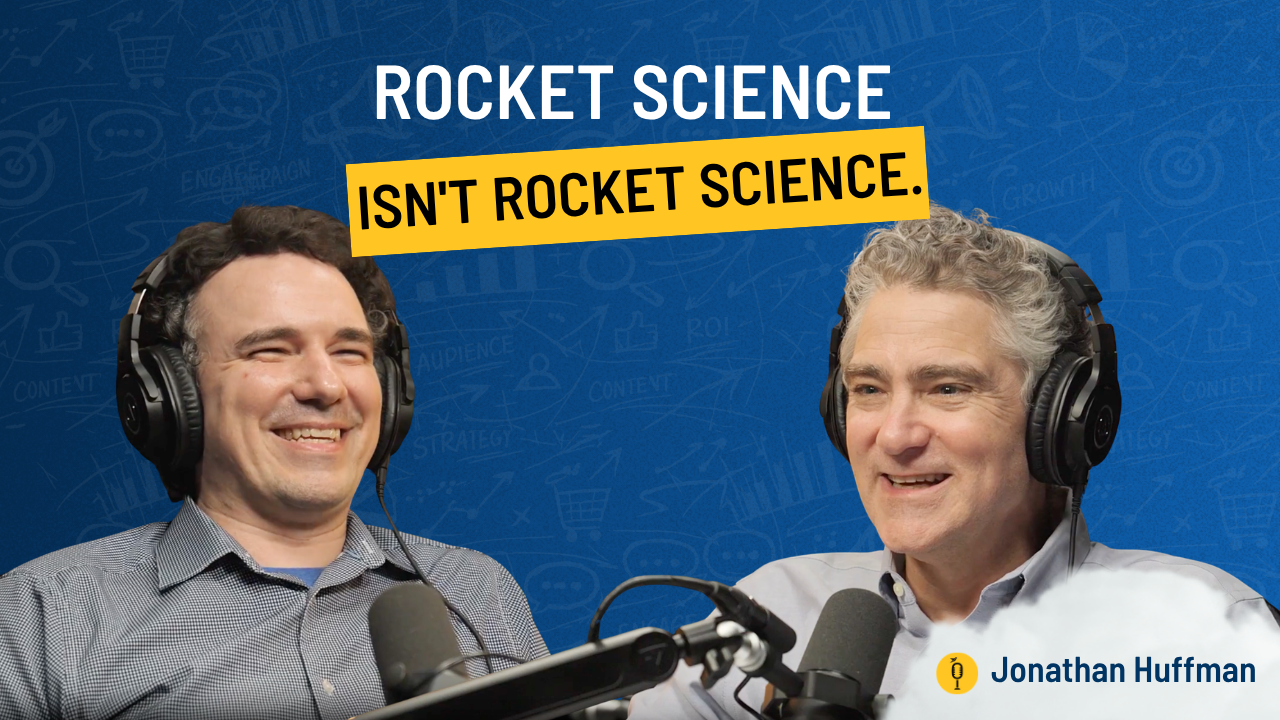
The way I put it to people is: yes, it's rocket science, but rocket science isn't rocket science. It's throw stuff out the back really fast, it pushes you forward, and figure out how not to blow up. That's the gist of it. There was a learning curve, but that's really what it is.
I got into this as a management consultant after business school, working in life science and biotech labs primarily. One of my projects was an operations improvement project in a biotech lab where I was optimizing sample management flows. They get biological and medical samples and need to run them through the lab. As part of that process I learned some of the tools. One of them was a field effect mass spectrometer.
Mass spec is basically weighing molecules. The way this one does it is it pulls an electron off a molecule of interest, accelerates it with an electric field now that it's positively charged, measures how long it takes to fly across a gap, and from that you figure out how much it weighs. The neat thing is that it doesn't typically break the molecule apart. Most ways of making an ion will fragment a molecule, but this is what they call a soft ionization method, so you accelerate an entire protein or biological molecule without it falling apart. That's really useful, because if you want to know the mass of the whole thing and it falls apart, you didn't get the mass right. You get better data.
So I thought, that's neat. Logged it away. I didn't know you could make ions without breaking molecules, but now I did. Moved on with life.
About a year after that, I wrote a short story on Quora, a sci-fi story about time travel. The CEO of a video game company read it and reached out and said, I want you to write for my game. He asked me to be the world builder for a game called Infinite Fleet. Look it up, it's awesome. Giant anime robots fighting aliens. Great game.
The thing about a giant anime robot is that it takes a lot of propulsion to move it around. His ask was to make the game world as scientifically realistic as humanly possible, and as a result I went and researched propulsion technology. What I found was that the only feasible way we know of to move something that big without breaking known laws of physics is ion propulsion, but ion thrusters as they stand today are far too weak to do it.
So I asked, how would I go about scaling up an ion propulsion system? It turns out it's roughly a threefold problem. There's power, which means you just need really big fusion reactors. There's not much you can do about that, it's a physics limitation. There's throughput rate, which is how much mass flow, how many milligrams or grams per second of gas you can get through the system. And then there's fuel, and what kinds of fuels you can use.
A traditional ion thruster uses a noble gas or a pure atomic metal as fuel. Xenon, krypton, mercury, indium, that kind of thing. They do that because if you have molecules and they fall apart, the components have different masses and they don't behave properly in the ion optics. They'll fly in different directions, hit the walls of the thruster, start spalling off material, and generally melt you down or cause the thruster to fail much more quickly. So they don't like fuels that aren't monatomic.
On the power side, there wasn't much I could do other than write into the game that there are really, really good fusion reactors. So the robots got really good fusion reactors, and that part was solved. The other two parts, though. On throughput, I learned some of the math. How do you get more ions through a system? You shrink the distance the acceleration happens over, and you get an exponential improvement in your flux. And how do you get access to fuels that aren't rare and expensive? Use molecular fuels.
Remembering that field effect mass spec system from the biotech lab, I thought, I bet I could build something that makes ions out of molecules and save a whole bunch of money on fuel costs. Xenon costs about three thousand dollars a kilo.
Richard Byrd
Wow.
Jonathan Huffman
It's the fuel of choice because you get really good performance out of it, but humanity gathers about seventy tons of xenon per year globally. That's all of it. It's used in semiconductors and a whole bunch of other applications. When you try to buy it, you can't really buy it in bulk. You have to get an allotment, and your annual allotment is the most you can buy. It's a giant pain to work with.
We can replace that in our thrusters with naphthalene, which is basically just mothballs. It's a similar mass of ions, so you get similar thrust per watt, similar performance to xenon, which is best in class. But it costs a dollar fifty a kilo instead of three thousand. There are a few other advantages too. The only way to do it is to ionize it without fragmenting those molecules, but if you can do it, it is a better approach.
Richard Byrd
That is interesting. How does naphthalene compare to argon on cost?
Jonathan Huffman
Argon I think you can get in pressurized vessels for about forty cents a kilo. So argon is cheaper. But the performance you get from argon is vastly lower in terms of thrust per watt. You end up consuming much more power to get the same thrust.
Richard Byrd
That trade-off is ever-present.
Jonathan Huffman
Right. And you can't store argon at the same density as xenon or naphthalene, so your tanks get bigger and heavier. You can't run it at the same power and get the same thrust, so you need bigger solar arrays. You're trading dry mass for cost, and dry mass has its own costs in terms of both maneuverability and launch cost.
It's an economic calculus that, notably, SpaceX has made. They run all of their Starlink systems on argon Hall thrusters today. Everything they launch now runs on that technology. They did it because there's literally not enough krypton and xenon in the world to supply the demand they have. If you can run on something better, you run on something better, and that's what everyone in government still does, because their volume is low enough. There's just not a good solution at large scale. Argon isn't really a good solution at large scale.
Richard Byrd
That's the SpaceX phenomenon. They're doing everything at scale. It's all about high production for those guys, so that makes a lot of sense for them. That's really interesting. Tell us a little more about what you're doing and how it relates to people here on Earth.
Jonathan Huffman
What we're doing is the propulsion system. It goes on a satellite. An ion thruster is the sort of thruster you use for in-space propulsion. You're shooting high-velocity ionized gas out the back of the system. It's extraordinarily fuel efficient, but relatively low thrust. You'd never use this for launch. If you get enough power, maybe you can use it for human transport, but that's a long way off.
Right now, if you're flying a human astronaut out to the moon, they're going to use a chemical thruster, because you get faster acceleration and you get there faster. But once you're in space and there's no air resistance, you can take a long time to accelerate in a lot of cases, and the fuel efficiency of an ion thruster will reduce the cost of the mission overall. That's why the most common type of propulsion system today is ion propulsion. It's used on the vast majority of all commercial spacecraft and on many government spacecraft as well. It's getting more and more ubiquitous as the technology matures.
Richard Byrd
That makes sense. There's not an argon gas station anywhere up there. You've got to carry everything you need for the lifetime of that satellite or spacecraft, so you want to use the fuel as efficiently as humanly possible.
Jonathan Huffman
Electric propulsion ion thrusters are the most efficient way to do it right now. So the market we're going to play in is disrupting the existing electric propulsion market. The way we do that is to be lighter, be cheaper, have higher performance, and run on fuels that are more accessible and store as a solid that sublimates, so you don't need a heavy fuel tank. Put all of that together, and if it's cheaper and better performing, you have a pretty winning combination commercially.
Every time we go talk to a customer, they say, if you can actually build that, we will buy it. Sometimes with more or less skepticism about whether we can actually build it.
Richard Byrd
If you can build it, we will buy it. That's the answer I usually get. That's a good place to start from.
Jonathan Huffman
For sure.
Richard Byrd
Where would you say your technology readiness level is today?
Jonathan Huffman
Right now we're at TRL three, a physics demonstration prototype. Our thruster runs on a MEMS chip built with a microscale semiconductor fabrication process. We built the first iteration of those chips at Oak Ridge National Lab, where I'm a principal investigator. Don't ask me how I ended up a principal investigator at Oak Ridge as a theater major. It's rare enough that they upgraded me. When they sent me the acceptance letter, they addressed it to Dr. Huffman.
Richard Byrd
So they just assume you have a PhD if you're even applying?
Jonathan Huffman
Apparently. But yes, I'm an investigator there. We built the first iteration of the chips, got the first prototypes back that we could run tests on in September, and they worked on the first try. They worked really well. What we've demonstrated is that we can make ions out of naphthalene, our target fuel, in our target environment, which is a vacuum, with our target chip geometry. So from a fundamentals of physics standpoint, the technology's proven.
We have some ways to go in terms of demonstrating it at flight scale. These things run on little tiny sharp emitter tips. We put six emitters on our first set of chips. Our future chips will have somewhere between two hundred and thirty thousand and a million emitters on each one. So we're a long way from a full scale thruster in terms of what we've measured. But we're building it now. I sent the first payment to our chip fab partner for the full-scale ionizer chips this morning.
Richard Byrd
All right, congratulations.
Jonathan Huffman
We're moving.
Richard Byrd
That is fantastic. How long do you foresee that next phase taking to get to a working full-scale prototype? Is that proof of concept?
Jonathan Huffman
That's what we should be able to do with the chips coming out of this partnership. The current estimated timeline for getting chips out is about six months. After that, probably a couple of months to get it integrated into the system, do baseline tests, and put it into big vacuum chambers where we can run full-scale thrust tests. There'll be a campaign of testing that follows the first delivery.
All the building of the other components has to take place concurrently with the chip fab process, which is the longest part. So we're going to be trying to finish off our power supply, our fuel delivery system, and our thruster chassis simultaneously, so that everything's ready the day we get the chips back. We'll see how it goes. It's R&D, so I wouldn't be surprised if there are delays, but that's the timeline as it looks from where we sit right now.
Richard Byrd
That's great. That's really exciting. It must feel like you're having a baby.
Jonathan Huffman
Since I started working on this, I've actually had two kids, so I'm familiar with having babies. This is a little different. With babies, you're scared of a whole bunch of different things. With this, I'm scared of one big thing. At the end of it, we turn it on at full scale, and do we get the performance we've modeled? That's the multi-million dollar question.
Richard Byrd
It's interesting. We've worked in a lot of different industries, and chemistry is one. In my mind, if you make it work in a small batch and you get all the same proportions and the same amount of chemicals in there, it should work no matter how big it gets. That's not true.
Jonathan Huffman
No.
Richard Byrd
And we worked with crazy smart people, chemistry PhDs, deep science guys and practical chemistry guys, and they've got their fingers crossed. They're super nervous until you prove it out. It's just not what you think. The only other thing I can think of that's like that is cooking. Just because you put a hundred times the cupcake mix in there doesn't mean you're going to get cupcakes out the other side that taste the same as the batch of six.
Richard Byrd
As we're talking about the circuitous journey, I have the term Blue Shoe Games for you. That was one of the stops along the way. One of the things you said about that experience is that at that company you made really great games, but you didn't learn how to make money.
Jonathan Huffman
That is a hundred percent the case.
Richard Byrd
Tell everyone about that.
Jonathan Huffman
Blue Shoe Games was my first startup. Out of undergrad, I took my English degree and went to South Korea for about two and a half years and was an English teacher there. I loved that job. Great country to be in, great people, and a great growth experience for me as a person in the world. No real growth opportunities professionally, though. You can be a teacher. That's what your visa says, and that's all you can do in that country.
So I was looking for something else to do after those first couple of years. I had a really good friendship with my roommate from college. We had been huge board game and card game nerds. We played all sorts of different stuff. We liked the way it got people together around a table and made people focus on the same thing while allowing casual conversation to flow around it. We thought it was awesome. So I reached out to him and said, I think we should start a board game company.
I'd done all the math in the background, because that's what I do. When I get an idea, I start doing the math. I'd concluded that with my savings from Korea I could start this company and build a small print-on-demand card game factory within the budget I had available. It wouldn't be quite up to industry standards, but close enough that the average person wouldn't be able to tell. You could publish games, print them yourself, and carry a gross margin at a reasonable price printing single unit volumes. Managed right, from a high-speed cardstock color printer, there was maybe half a million in revenue potential if you grew it that much.
So I said, I think we should try to do this. We came up with some ideas for games and got two of them all the way through the development process. I had my little sister, who was an art major, do the art for one of them. I had a friend who was an anime nerd draw little chibi characters for the other one. It looked really good. Great fun to play.
We had no distribution. And we had no awareness that that was going to be important coming into it. I moved back to the US, we moved to North Carolina together, I got an apartment, and we built this little factory in my kitchen. I daisy-chain wired the UV coating machine into our oven outlet because it was the only one I had the power for. Did this whole little factory build, which was great fun. And it worked. We could print games, our unit costs were low, and we could ostensibly make a gross margin on each one.
We sold about twenty games ever.
Richard Byrd
But it was profitable.
Jonathan Huffman
It was profitable if you counted only the fractions of the time we spent on the machines as the time we had to live.
Richard Byrd
Business valuation. There are things to get swept under the rug.
Jonathan Huffman
It was a great learning experience. We had great feedback from people playing the games. I learned a ton about product development, how to build a physical thing. I taught myself a little bit of programming and a little bit of electrical engineering. Really basic stuff, but I got comfortable that I could learn things, and I loved the experience of building. Ultimately we didn't make any money, so the business closed. But it was the impetus for me to go to business school, study entrepreneurship, and get into the world I'm in right now.
Richard Byrd
One step on the circuitous journey. I love it. As I hear about all this, I can't get away from something you said in our pre-interview that has really stuck with me, which was this idea of the Dunning-Kruger effect. I thought it explains so much about you. For those who don't know it, walk us through it.
Jonathan Huffman
My hot take is that the Dunning-Kruger effect, which is the psychological phenomenon where people who don't know anything about anything think they know everything about everything, is a feature, not a bug.
When I interact with traditionally trained scientists, many of them are very conservative about what they've discovered and risk averse about taking steps to do anything with it. There are a lot of these brilliant people who, if they don't know everything about something, are smart enough to recognize that fact. And they make decisions based on the risk associated with not knowing. They think, I know enough to know that I don't know a ton, so I'm not going to move.
The Dunning-Kruger effect, and this is the part that's going to be controversial, is the thing that gets you to start trying stuff. If you believe you can figure it out, you jump off a cliff and take a big risk, because you think, I can handle it. What's the worst thing that could happen? And then all the terrible stuff starts happening, but you're already committed and you just have to figure it out. That creates the forcing function that drives a lot of progress and a lot of success.
In my life, that's been my experience. I've jumped into a bunch of different things that are stretches, where at the beginning I even knew that I didn't know what I was doing. But by jumping in, I forced myself to go figure it out. And I've found that learning isn't an impossibility. You can go learn stuff.
The nice thing about physics is that it works the same for everybody. Whether you like it or not, you can go read all of the internet about the thing you want to do, and to the extent that you can do the math and figure it out, you're going to be as well positioned as anybody to go build in that field. You won't have the network, maybe. The right way to do this would have been a traditional science degree, no doubt, because there's a credibility barrier you have to overcome, and that basically takes doing the experiment and getting it to work. But people are a lot more capable than they think they are of learning and adapting and figuring stuff out on the fly.
Richard Byrd
I agree with that. We work with a lot of technical experts, and everybody around them will say, this guy's the expert on this topic. And you'll say, you're the world-leading expert on this topic. And they'll say, oh no, I'd never call myself an expert on this. It's because they know so much that they know everything they don't know, and it can be paralyzing.
We see it a lot on the commercial side with cross-selling. We'll be working with a company that has acquired a bunch of other companies across different disciplines. We'll say, when you're in the room with this person and they need the other thing you guys sell, why don't you talk to them about it? And they say, well, I don't know anything about that topic. And I say, sales guys don't know anything about any topic, but they sell. Can you at least say, it sounds like you should meet my colleague who really knows a lot about that? And they say, well, let me think about it, I don't know.
Whereas somebody who isn't an expert and doesn't know all the unknowns says, oh yeah, of course we can do that, our company's great at it, whether they are or not. And then they'd better figure out how to be great at it real fast.
Jonathan Huffman
Exactly.
Richard Byrd
We see it all the time. It's such a great mindset, and I do think people are more capable than they know. And we have this wonderful thing called AI now, where you can get caught up really fast on things you didn't know much about and get a layman's explanation of some pretty complex things.
I think the thing that holds people back is that sometimes they don't want to learn. The experts do. They want to learn and go deep and narrow in their thing. But what holds other people back from taking advantage of the Dunning-Kruger effect is that they think, I'm just going to stick to my lane. For it to really take effect, you have to be courageous and confident. I always say overconfidence is kind of my superpower. My wife would agree. But I think it is a superpower to be able to be fearless and say, look, I'm going to go in and learn about this, and I'm going to get kicked in the face a few times, but that's okay. I'll learn from that too.
Jonathan Huffman
Getting kicked in the face. Let me tell you a story. There's a guy at the Jet Propulsion Laboratory named Richard Hofer. Brilliant, brilliant expert in electric propulsion, probably one of the top couple of guys in the world at it. I got on a conversation with him about what I was trying to build. It was really early on, the very first pitch I ever put together for the company.
The thing that had captured my imagination was the idea of a mission to take a CubeSat on a sample return mission to Phobos, the moon of Mars.
Richard Byrd
Oh, wow.
Jonathan Huffman
And to fly the whole mission on one kilogram of fuel. I figured you can do it if you just crank the voltage on the ion thruster high enough. You run it at such and such a voltage, you get twenty-seven thousand seconds of ISP, one kilogram of fuel gives you so much delta-V, and you can fly all the way to Mars and back and do this whole mission.
I was talking to him about it, and he said, that is the dumbest thing I've ever heard.
And he was right. The reason he was right is that missions don't optimize purely on fuel. The thing I hadn't taken into account was dry mass, the mass of the power supply necessary to get to that voltage and run at that ISP. He said, that's dumb. What you should do is cut the solar array in half, run it at a third the ISP or lower, and carry three kilos of fuel. Because the mass you'll save on the power supply and the solar array will be more than two kilograms, and it'll be cheaper and faster because you get better thrust per watt at the lower ISP.
And I thought, oh, shoot.
That pitch, the one-kilo mission to do a sample return to Phobos, was the thing that got me into Techstars. And as soon as I got into Techstars, having just had this conversation, I said, I have to scrap my entire pitch, guys. We're going to start from scratch, because this mission is dumb now. I don't think that endeared me to the Techstars team very much, but they rolled with it, to their credit.
Richard Byrd
That is so interesting, because really smart technical people are the most honest people in the world. They don't sugarcoat things. It's going to come at you.
Jonathan Huffman
It's great, though. You need somebody who will point you in the right direction, and he did. He didn't mince any words about it, and I'm glad he didn't, because it made me take it seriously.
Richard Byrd
You do get kicked in the face, and in the process it really grounds your thinking.
It's interesting to think about that with the weight added and having to carry the fuel. It reminds me, I'm an avid outdoorsman, I love backpacking. It's similar. Your pack doesn't feel that heavy in your living room, but when you're at altitude and on the trail and you've had it on your back for six hours straight, it feels really heavy. And your limiting factor is always water, because it's the heaviest thing you're going to carry, and if you run out of it you're in big trouble.
Jonathan Huffman
Just like fuel on a satellite.
Richard Byrd
It's the central thing you're considering when you plan your trek. Where are we going to get water? I can't carry enough for this many days.
Jonathan Huffman
Purification tabs and the filter straw. In situ resource utilization, ISRU. That's the name of the game in both space and the backcountry.
Richard Byrd
And if you're in a place with no resources, you've got to watch it too. I love it.
As we think about our audience, what's the one thing you'd really want people to take away about thrust and ISP as it relates to your thruster?
Jonathan Huffman
With ion thrusters, not as much with Hall thrusters, but with gridded ion thrusters and micro spray thrusters, you can pick your ISP. You just change the voltage. The accelerating voltage picks your ISP. So there's an optimization function for that, and the thing that determines where the optimum is is really the power density of the system.
That's what my company is about. We're trying to build the smallest, lightest, most power-dense ion thrusters that have ever existed. And when you do that, the math works out so that higher ISP is better, higher power is better, more agility in orbit is better, and more delta-V is possible. It enables missions in a category that can't be done yet. So that's where we think we're headed.
Short term, buy a thruster from us and it'll make your satellite cheaper, lighter, more maneuverable, and cheaper to operate with less expensive fuel. Lower dry mass, all of your engineering margins get better. It's a win across a whole bunch of different criteria.
Long term, we ran the math. You can build a Starship payload scale vehicle, a hundred and fifty thousand kilo wet mass vehicle, put a couple of megawatts of power on it, and fly it forty thousand meters per second of delta-V if we can get the longevity of the thrusters to where we think we can get it. That's a round trip to Jupiter and back. That's asteroid mining territory. You can do large scale physical industry in space with that, and that's with a thirty-three percent payload mass fraction, so fifty thousand kilos of that is cargo. You could run around the solar system carrying bulk goods.
Which isn't a thing anybody does now, because it's financially prohibitive in all cases and physics prohibitive in some. The power density just isn't there to attempt it for some mission categories.
That's not where we're going in the next five years. The next five years are all going to be about data centers in space and satellite mega constellations for internet, for earth observation, for various other kinds of services from low Earth orbit. But the five years after that, semiconductors in space. Crystal growth is better in microgravity. You can do ultra-high vacuum processing of materials with lower impurities. You get a free, very effective vacuum chamber from space itself, where it starts to make sense to do a variety of interesting material science industries. If you can get the stuff up cheap, move it around in orbit cheap, and get it down cheap, that becomes cost competitive with the ground.
I know from working in MEMS, building these chips, that operating a clean room to build microchips on the ground is extraordinarily expensive for air purification. Just the continuous operating cost of the air purification is very high.
Richard Byrd
So you put it in space. Free vacuum all the time.
Jonathan Huffman
Exactly. You've got some opportunities there. You have to make the economics work, and we think we're one part of that puzzle.
Richard Byrd
When you think about all the commercial opportunities this could unlock, it's mind-numbing. A whole ecosystem of industry that people haven't even imagined yet.
We were talking before about helium-3. What you're describing there would be plenty of payload to make helium-3 worthwhile if you could load up one of those containers and bring it back down to Earth.
Jonathan Huffman
You'd have to process a whole lot of lunar regolith to get fifty tons of helium-3. That would be a mining operation like, I don't think we have an Earth scale mining operation that big. But fifty tons of helium-3 would be enough to power the Earth for a long time. Our lifetimes, a little longer than that, probably.
Richard Byrd
One of the things you talked about there was maneuverability, and I think that's something people don't necessarily think about when it comes to satellites. I was reading that Starlink tracks every movement up there, and they had something like a hundred and forty-three thousand evasive moves in one period. I don't remember what the time period was, but it wasn't very long. I was like, that didn't seem possible.
Jonathan Huffman
I haven't looked at the most recent numbers. I know that two years ago they were doing fifty thousand collision avoidance maneuvers across a six-month period that they publicized.
Anything that's going to stay up for more than about a year probably needs a propulsion system to do that kind of maneuvering, and also to do station keeping. At low Earth orbit there's wind resistance that will slowly deorbit your spacecraft, and that's actually a good thing, because it means that if your spacecraft dies it will clean itself up. But there are a lot of situations where a propulsion system really is necessary on a spacecraft. Enabling that for the industry, making it economical for the industry even at micro-satellite and CubeSat scales, we see that as a benefit we can bring to the market.
Richard Byrd
Absolutely. That's a good differentiator as you're thinking about your technology versus conventional technology. It's interesting, because I think about the satellite industry and aerospace and LEO and all these things, and it seems so frontier and out there. And yet there are these grandfathered-in, tried-and-true technologies that you're going to have to overcome in the marketplace. You have to really change the way people think about it.
Jonathan Huffman
That's absolutely right. Think about how much the market has changed in the last five or ten years. If you were building a satellite TV satellite, you were going to build that thing once, put it in a geostationary orbit where it has a field of view to most of a country or all of a country, leave it there, and want it to work for thirty years. You don't ever want to replace it. That kind of a satellite in the nineties and two thousands would cost you nine hundred million dollars. Half a billion to a billion to build.
Richard Byrd
Wow. Pretty soon you're talking real money.
Jonathan Huffman
Pretty soon you're talking real money. And if it fails, it's going to take you a year to build a new one. You're going to lose not only the hundreds of millions you spent to build it, but the billions of dollars of revenue from subscribers who don't get your TV service anymore. You can't have that happen.
So the build philosophy of that era was ultimate reliability. Nothing can fail. We have to have redundancy for everything, the most tried and true tested components. They built around that philosophy and it made sense for what they were doing.
Now, what SpaceX is doing, a V2 Mini is probably under eight hundred thousand dollars to assemble the whole thing. They've got thousands of them up there. If one of them fails, somebody's internet speed drops by four percent for fifteen minutes out of every ninety. It's not a revenue impact. The capital cost to build the asset isn't bad, and since it's in LEO instead of GEO, the launch cost isn't as bad to get a replacement up there. And they're doing those launches every couple of days.
So all of the things that made that initial ultra-risk-averse philosophy make sense no longer really apply. We're in a world where it's going to be about, can I scale production? Can I deliver a reliable product in the quantities this industry needs? And does it work?
For a constellation client, I don't even think our performance advantages are really the selling point. It's, this is going to reduce the unit cost on my thousands of satellites by a couple hundred thousand dollars each. That'll be a hundred million in savings, or a billion, depending on the scale of your constellation, every year, because you're launching thousands of satellites every year to replace the thousands that are coming down every year.
That's where we think the market is going, and penetrating that market changes as well. Now I don't have to become ultra-reliable before anyone will buy it. I can do a pilot project with a constellation builder. Fly five satellites, or put it in a lab for a few months, and then put it on a few satellites, and if it works, put it on all of them. And if it doesn't work, the incremental cost for them to replace those satellites is a few million dollars instead of a few billion.
Richard Byrd
That's such a mindset change. From this can never fail, redundancies upon redundancies, over-engineered, to more of a fail fast model. SpaceX really changed that by the scale at which they had to operate.
Jonathan Huffman
And more Dunning-Kruger stuff. It's like, yeah, we can catch a rocket with chopsticks. Why not?
Richard Byrd
That's right.
Now I'm thinking about your market. Let's talk about commercialization. I know you're a few years out, you've got to go through all your technology readiness stages. But as you think about the market you want to sell these to, who do you see as your primary market?
Jonathan Huffman
Large scale constellation builders initially, for sure. We think there are at least twelve constellations with a credible funded chance of putting thousands of satellites in orbit per year, across about ten separate companies. SpaceX has three, Blue Origin has two, so some of them are doubled up. But at least ten different companies, at least twelve separate constellations.
Each of those constellations is going to need thousands of thrusters every year. There are something like twenty-seven different producers of Hall thruster systems today, but only SpaceX has ever built more than two hundred of them in a year, as far as we can tell. They are not accelerating to scale at the rate the industry is going to need them to.
So what we need to do is get the product to market on a timeline that meets that. Since we're building in a chip fab, we sort of have chip fab scale economics built into our systems. It's expensive and hard to stand up a chip fab process, but once it's stood up, the chips individually are rather cheap and they can be produced en masse. Even if we serve the entire thruster market as we project it ten years out, which is optimistic because we're a startup and startups are optimistic, we're a few percent of one chip fab's capacity. A tiny fraction of the volume they do on an annual basis.
Richard Byrd
Sure.
Jonathan Huffman
So we're not going to stress the infrastructure to build this at scale. We can probably do thousands of thrusters in year one after we reach a flight qualified product. That would put us in a position where we're immediately the largest or second largest producer of electric propulsion in the world if we win one contract from any of those ten to twelve constellations.
Richard Byrd
For sure. And then you also have the low cost fuel source as a point that enables that scalability.
Just to backtrack a little, for people who don't know about these mega constellations, talk to everybody about what the scale of that is.
Jonathan Huffman
I want to say it was late October, early November when Elon Musk posted on X that he was going to build data centers in space. That post probably created six space unicorns, because there were several other companies positioned to immediately move toward building data centers in space. One company in particular had already been working on it for a while beforehand, but that post catapulted them into unicorn status almost immediately.
There's been a rush to go do it, because there are characteristics of different orbits that work really well for continuous, always-on solar energy at high flux from solar panels. That's one of the few ways of scaling the power needed to run giant AI data centers that makes any sense in the near term. The turbine industry is so slow that gas turbines and the other generation mechanisms that rely on running a turbine are going to have delays building generation capacity. Solar you can continuously scale, but on the ground it doesn't work so well, because there's nighttime.
In some orbits in space, you can get always-on solar, or very nearly always-on solar. Peak solar all the time. That's the advantage they're trying to capture.
Richard Byrd
And it's not in anybody's backyard.
Jonathan Huffman
Not in anybody's backyard. There are some launch regulations, but there's not permitting in the same way. And there's a way to do it that has some potential to be very competitive with data centers on the ground. So SpaceX wants to do that, and a bunch of other companies want to do that. There's going to be enough demand through the AI boom to utilize all of the capacity they can build and more.
Funding has gone to those companies, and they're building, trying to get to demo missions and then to large scale constellations. And when I say large scale, SpaceX is trying to build a million satellite data center constellation in the next five years or something like that. It's mind-bogglingly high scale. We're in a world where all of the satellites humanity has ever launched is less than fifty thousand.
There's another one that's trying to build a hundred thousand. There's one that says we can send up twenty-five hundred in a single launch and we'll do many, many launches. There's another one that's eighty-eight thousand. The scale of all of them is getting very, very large, and it makes a lot of sense, because you're building processing capacity and you want to build at as big a scale as you can.
Richard Byrd
There are some questions about whether the orbits can even handle that many satellites. And are there enough radio frequencies to handle that?
Jonathan Huffman
They'll use laser comms, beamed communications that are focused instead of polluting all the frequency. There are ways to work around some of the frequency band limitations. But the result of all of this is that every single one of those things they put up is going to need a thruster. So there's going to be a significant spike in demand for what I'm building in the very near future.
Richard Byrd
I like it. And I love the idea that you're building for what is to come. You're building for the scale already, building to meet that demand straight off the bat.
Jonathan Huffman
And we want to be able to do that. If you need ten thousand thrusters in a year, call me.
Richard Byrd
I like it. The days are coming. A lot of Elon's predictions are accurate from an end view perspective, but not necessarily over the timeframe.
Jonathan Huffman
His track record on timeframes is maybe not as good. He usually bets that he can move a lot faster than things can actually move. Which is good for me, because I'm betting I can move fast as well, and I need to hit the timing right with flight qualification to capture a lot of this demand.
Richard Byrd
That's super interesting. So you've got your market, you've got your technological differentiation. Check one, check two. What about the competitors you see out there? Is anybody rethinking the way thrusters are made in a way that's similar to yours?
Jonathan Huffman
The clickbait I click on every single time I see it is, new propulsion technology will get us to Mars in a week. Every time I see it, I click it.
Richard Byrd
And your BS meter is pegged to full.
Jonathan Huffman
It always is, but I haven't seen anything that scares me yet. I will always look to see if it scares me, but I haven't seen anything yet.
There are some really good use cases for other propulsion technologies in the far reaches of the field. I think if what we're building works the way we think it will, we will make the Hall thruster obsolete. Full stop. There won't be a reason to fly that tech anymore.
But gridded ion propulsion has some unique characteristics for really long duration missions. It will take us a long time to prove we can do the same kind of durations they can, and there's risk associated with whether we can get there. We're pretty sure we're going to get to enough longevity to serve the constellation market. They don't need all that much delta-V and they don't need all that much longevity. They're looking to burn their satellites up every five years anyway. But if you want to do that round trip to Jupiter, we have a lot to prove before we get to that point. I don't think the gridded thruster technologies can get the delta-V to do that trip, but they've got the longevity to make it to Jupiter at the very least. So there are some use cases there.
There are also use cases in the micro-propulsion field. We're not entirely sure how small our impulse bit will get. That's the minimum possible amount of push you can give to a spacecraft.
Richard Byrd
What do you use that for?
Jonathan Huffman
The smallest impulse bits are used on space telescopes, to orient them to point at specific things. You want James Webb to shift by a tiny fraction of a degree so you can track a star as you're orbiting. You use a really low thrust, typically a micro spray thruster, to push on one edge of it. You want the smallest possible amount of thrust you can give at one time, where you turn the thing on for a millisecond and it just puts out a tiny puff of ions.
That use case, we don't know if we'll apply to. I don't think we will. The way we're designing the fuel feed system isn't going to be quite precise enough for that world. So there will be markets for other stuff. We think we're going to get a lot of it, and I haven't seen anything else yet that makes me scared. There are a few maybes, but nothing that's made it far enough to worry me.
Richard Byrd
I can't wait to see as you develop further and prove out that technology. I think it's such a novel idea. Conceptually, I love what you guys are doing.
Jonathan Huffman
Conceptually. Don't get me wrong, there's still technical risk here. We could fail completely. The chips might not work the way we want. So temper expectations a little. But in the models it works really well, and I don't have any reason yet to believe we can't build what we've modeled.
Richard Byrd
To this stage of the game it's been very technologically focused, jumping from one technical hurdle to the next. Now, as you think about building out the company, and you've still got a lot of engineering between now and when the first one launches, tell me what that journey looks like as you're trying to build out an organization.
Jonathan Huffman
That is a unique and entirely different challenge. I said earlier that physics works exactly the same for everybody no matter who you are. Hiring people and managing people and relationships aren't like that.
Richard Byrd
It isn't like that. Old skill sets may not apply.
Jonathan Huffman
In the near term we're looking to hire for a few engineering roles and for a federal business development expert to run that part of the go-to-market strategy. We've also been onboarding partners. We got a little bit of funding a couple of months ago, and we've onboarded partners over the last few weeks to build some of our components and help us engineer others. Managing those relationships and those projects is one of the things that's top of mind for me over the next six months.
And I need to find a really good fluid dynamicist. So if you know a guy, I know a guy.
Richard Byrd
I love it. The people part is always the hardest. I'm a people person, I love people, but it's always the hardest part. My dad was an entrepreneur and he said, business would be so easy if it weren't for employees and customers.
The other thing you've got to watch out for in your industry: a friend of mine in the seismic industry said, the problem we have in this business is our PhD to revenue ratio is off. You might run into that same thing.
Jonathan Huffman
Seems possible.
Richard Byrd
You mentioned the business development side and funding. Now you've got to go ring the investor bell. How are you thinking about that?
Jonathan Huffman
I have thought about that a lot. From the time we got our first positive test results out of the first thruster chip we built, I started fundraising the next day. I was trying to do a seed round, and the feedback I got was that we were too early for a seed round, that there was still too much technical risk for most venture capital firms.
Richard Byrd
It's a seed round. Come on.
Jonathan Huffman
Right, we're in the seed. But what the real issue is, I talked to a whole lot of venture capital firms where the response was, this looks awesome, call us when you have a lead investor. A couple of them elaborated: this looks awesome, call us when you have a lead investor, because we don't know how to do the technical diligence on this. We don't know how to check your math.
It's a pretty unique venture capitalist who has the background and understanding to actually look at my numbers and figure out whether I'm for real. So that's been the barrier. It's early enough that there's still technical risk, and there are people who say, from a business case standpoint this looks great, your model looks great, we don't know how to test whether your model is right. It's been right so far, but there's more scaling that has to happen. And to your point earlier, doing it right with one emitter and doing it right with six emitters is different from doing it right with a million emitters. So we've got a hurdle to get over there.
Now, I have been extraordinarily lucky, because I found the one-in-a-billion guy who was able to recognize what this is and how it works and understand the science of it immediately. He has joined our advisory board and has invested as an angel investor. A large check. He put in a million dollars.
He's a VP at Firefly. He was at SpaceX for ten years before that. The way he put it to me is, life wrote me a lotto ticket with the SpaceX shares, so now I'm in a position to just invest in cool stuff. But before working at SpaceX, he was at JPL during his academic career working on micro spray field effect electric propulsion.
Richard Byrd
That sounds like your guy.
Jonathan Huffman
It's the one guy in the world, probably. As soon as I told him what I was doing, he said, oh, I get that. And I said, you do?
Richard Byrd
Awkward.
Jonathan Huffman
Got really lucky with that. It has enabled us to start the chip fab production process, start the other vendors for our power supply, onboard a couple of people. We can build an organization now.
We'll see how the rest of the funding plays out. There are some conversations ongoing. I've met a couple of other venture capital firms run by ex-NASA people who understand the stuff. Not as specific of expertise as this first fellow, but not uncomfortable with it. We'll see how that plays out. At this stage we're running on trying to make technical progress, because the more we eliminate those technical risks, the more comfortable everybody gets, including me, going forward with larger scale investment.
Richard Byrd
Speaking of that, the hardest thing in entrepreneurship is getting the courage to jump ship from a well-paying job and get the home front on board with it. How'd that go?
Jonathan Huffman
Oh, man. Right at the beginning of 2023, I told my wife I wanted to quit my consulting firm job and start a space thruster company. And to her credit, she said, okay, write me a business plan on how that's going to work.
So I wrote her about a thirty page business plan. She read it, we talked about it, and she said, okay, go for it. And I said, I love you. I love you so much.
She's super sharp. She took her time to do a little bit of the diligence and understand what this was going to entail. She was on board, and she's been super supportive ever since. I couldn't do it without home front support. It wouldn't work. It's been such a blessing to have her. She doesn't really get the science of it, but she's been a background advisor on a whole bunch of things. When I need to make a good decision, I run it past her, and she hasn't led me wrong yet.
Richard Byrd
If you don't have that support on the home front, it makes everything, I won't say difficult, maybe impossible is the right word.
We talked about time travel earlier. Let's talk about it again. Let's go five years from now. What does Orbital Arc look like? Where are you?
Jonathan Huffman
Five years from now, I want to be flying about twelve thousand thrusters a year.
Richard Byrd
Wow.
Jonathan Huffman
Twelve, twelve five. A quarter of the market at least. I think there'll be demand for fifty thousand a year by then, so I want at least a quarter of the market. I think we may blow past that, but at least that much. That'll put us in a position to grow into a company that can do a lot of different things.
I'd also like to try to build this space truck, the giant interplanetary mining vehicle I've been thinking about, and be a logistics layer for deep space. There are a lot of orbital transfer vehicles and other providers that work in lunar space, from here to the moon, so we'll have competitors there. But I don't think there's much that can compare if you're going out past the moon, to Mars, to the asteroid belt, to near Earth objects.
Richard Byrd
That's beyond a moonshot.
Jonathan Huffman
Beyond a moonshot. I'd like to try to build that. It'll take a lot of power, and I'll look for good ways to generate it. The further you get from the sun, the less effective solar gets. There's a point where it switches to being better to do nuclear. I kind of want to try to build that nuclear electric propulsion system at large scale and fly big spacecraft for mining. That would be really cool.
Richard Byrd
It brings you right back to your giant flying robot base.
Jonathan Huffman
Yes.
Richard Byrd
As long as you don't turn into a Weyland-Yutani style megacorporation.
Jonathan Huffman
We're both sci-fi nerds here.
Richard Byrd
When you get like that, just remember us meager people you were on the podcast with.
Jonathan Huffman
Of course.
Richard Byrd
I love it. This has been a great discussion. What was the position you were looking for again?
Jonathan Huffman
A fluid dynamics expert.
Richard Byrd
All right, if you're a fluid dynamics expert, how do people get in touch with you, Jonathan?
Jonathan Huffman
You can reach me on LinkedIn, that's probably the best way. Look up Jonathan Huffman or Orbital Arc and you'll find me.
Richard Byrd
Thanks for being on the show. It's been great.
Jonathan Huffman
Thank you.
Richard Byrd
That's a wrap on today's episode. If you enjoyed it, consider subscribing, sharing, or spreading the news about us on your favorite channel. Thank you for tuning into Above the Clouds: Stories from the Boardroom. Until next time, stay above the clouds.
Let's get your wings ready!