September 30, 2026
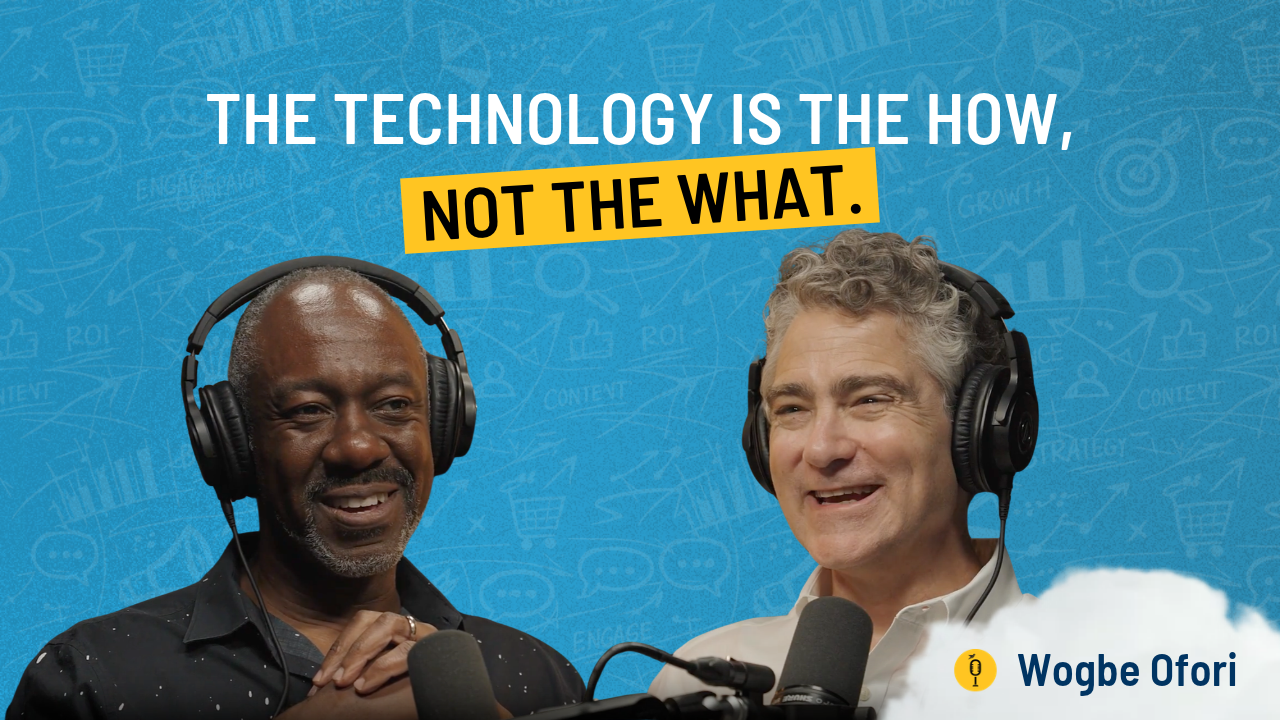
Wogbe Ofori is the Founder and Chief Strategist of WRX Companies, a Houston-based strategic advisory firm that bridges the commercial gap between science fiction and today. Most of his work sits in space technology commercialization, helping companies turn remarkable engineering into something a buyer will actually pay for.
His advice to space companies sounds backward at first: stop saying "space" when you sell.
Because cool doesn't close deals. Value does.
Wogbe and Richard dig into why the best mousetrap doesn't always win, where the real money in space is today, and whether orbital AI data centers could be the killer app the industry has been waiting for.
They also get into the overview effect, what it takes to tell a CEO they're part of the problem, and what the next five years could look like for the space economy.
If you've ever been told your product speaks for itself, this one's for you.
Richard Byrd
All right, welcome to the show. Today we have a very special guest, Wogbe Ofori with WRX Companies. Before we jump into it, I'd love for you to introduce yourself and tell our audience a little bit about you and what your work looks like at WRX. What are you toiling your life away doing over there?
Wogbe Ofori
Oh, man. Richard, first off, thanks for having me. This is a special opportunity, so thank you very much for having me on and bearing with me while I run my mouth for a few minutes.
Richard Byrd
Well, you've been such a busy guy. I'm glad we were finally able to get you in here and let people know what you're up to.
Wogbe Ofori
Right on. So WRX is a strategic advisory firm, and there are a number of different ways to describe what I do. If I really want to sound fancy, I say we work with organizations that are dealing with emerging technologies and act as the commercial bridge between sci-fi and today. Basically, it's consulting. The Texan way to say it is that I help people see around corners and think things through in order to make wise decisions and get stuff done.
Richard Byrd
That's a pretty good Texas accent for a New Yorker.
Wogbe Ofori
Thank you very much. I'm here every Wednesday, folks.
So in terms of the day-to-day, I'm a strategist. It's a very small practice at the moment, but everybody at WRX is an analyst. You have to have analytical thinking that is always driven by curiosity and is looking to understand the information that is present and trapped in the world around us. By seeking not just knowledge but understanding, we translate that into insights and guidance that hopefully influence decision-making.
Another element of that, on the influence side, is to extend the client's influence out into the marketplace, what I call to the horizon or just beyond the horizon. Especially when we're talking about hard technology in emerging markets, how do I help pave that way for the clients, and also gather intelligence out there that I can bring back to help inform their strategic decision-making? That's what WRX is about.
It's very journalistic in some ways, but practical. I spend a lot of time every day doing what we call research, recon, and intelligence, which is just being aware of what's happening out there. This is a really interesting time because there's so much happening. The overwhelming majority of my work right now, at least the work that pays me, is in space technology commercialization. But to really make that applicable to building out the space economy, I have to be aware of what's happening in many parallel sectors. I'm looking at everything from healthcare to other areas of technology to politics, because that affects policy, no more so than at this time. Then I synthesize all of that and use it to orchestrate opportunities, curate partnerships, and provide insights and guidance that hopefully turn into intelligence.
On a day-to-day basis, a lot of it is doing that research and then producing artifacts from it. We have something called analyst notes. In the financial sector, they put out equity research notes. It's a very similar thing. We write notes that look at a particular issue within the sector, and usually they start out with understanding this, breaking down that, or doing a deep dive on something.
When I'm actually with clients, we're talking things through. Another way I describe what I do is that I'm a cognitive expansion port for my clients. Their brains are maxed out looking at various things, and they get to plug a Wogbe in and say, okay, help me think this through, help me see this a little differently.
Just recently, on a chart, I was labeled POP, which stands for purveyor of perspective. A client wanted to see who was involved in a meeting, so I put together a chart on a soccer pitch with each person on it, and I was off to the side in the coach's slot labeled POP. So that's another label I get to wear sometimes.
Richard Byrd
I love it. In our consulting practice, mine took a slightly more negative approach than purveyor of perspective. It's the crusher of cherished assumptions.
Wogbe Ofori
But that's necessary. Sometimes it's like, take your medicine. Sometimes you have to have those tacit assumptions ground down to a fine powder, put back in your tea, and served up.
Richard Byrd
I love that you're talking about the analytical side of things, because I'm a firm believer there are only two kinds of people in this world: analytical people and non-analytical people. And it's funny, you'll find people in jobs where you would think they'd have a mind for analyzing things and providing insights, and then you talk to them and you're like, wait a second, you're in the wrong category for this role.
Wogbe Ofori
See, Richard, you just slipped up, because you said "you would think."
Richard Byrd
There we go. You're crushing my assumption. Touché.
Wogbe Ofori
I have a gift that I give to some clients. It's a jigsaw puzzle with an old-timey, 1700s-style anatomical drawing of a person's head, and it says "problem" and "solve," but above it, it says "think it through." That's one of my mantras. Sometimes I'll ask, are you thinking this through, or have you thought that through? And it's not very common that the answer is yes. Or they thought through one path and didn't do the spaghetti plot of the numerous ways this could actually work out.
Richard Byrd
That's right. So you've spent twenty-five years doing this, working with companies across different ventures and industries. You mentioned the political landscape, the technology landscape, medical, space. What's the through line for all of this?
Wogbe Ofori
I've asked that question, and others have asked that question, and the only answer is me. I'm the through line. It's my ability to go into all these different things as a generalist, and I really do believe in the power of being a generalist. There are certain things about a particular situation or sector that are unique to it, but usually it's no more than 20%. About 80% of whatever they're dealing with has been dealt with somewhere else. You can find an analog to it somewhere else.
It's been serendipity that's taken me along. Somebody would say, I think you could do that. I've never seen you do it, I don't even know what it is, but you seem to be the person who can figure stuff out. Maybe it was ignorance, not knowing that I wasn't supposed to do that. Then you put those analytical skills to the test. The very first thing is to come up with a model. What does it look like? Then break it down and see if you can rearrange it and put it back together.
A lot of it has been driven by personal interests. I say that I'm pursuing alignment with my design, but that takes a good while to figure out. Right now I think I'm pretty well aligned with my design, but it's taken me all over. I was in sports medicine for a while. I was buying, building, and operating airports for a while. I did legislative policy, and not just analysis. I actually went and wrote legislation. That didn't work. I was in the music business for a while. You just move to where you think, I see something here, and I have a unique perspective or a way of driving value that maybe others don't.
It took me a while to understand how other factors play into that, some of them circumstantial, some of them political. There are all sorts of factors that go into whether or not you're going to have success in something. A lot of the things I tried didn't work.
Then there would be people who came to me, kind of like the old TV show The A-Team. The premise was always that people got into a situation that was over their heads, nobody else could help, and somehow somebody knew somebody who knew how to get in touch with Hannibal. Hannibal comes in with his disguise, and if the people were really deserving, they all come in, do the build sequence, and start shooting some things.
Richard Byrd
And B.A. Baracus.
Wogbe Ofori
B.A. Baracus comes in, and they do their thing. That's pretty much how I've approached my career. Somebody would get in touch with me and say, Wogbe, we need your help. Sometimes people would do the Star Wars thing: Obi-Wan, you're our only hope.
It's also like a lot of those movie tropes where I'm the person with the special skills who comes in and does things, but I'm also expendable. After the job is done, the helicopter flies away and leaves you there, so they can wipe their hands of this nasty business. That was happening to me too often.
Richard Byrd
The joys of being a consultant.
Wogbe Ofori
Exactly. That's a selling point. If things go wrong, just blame it on me and get on with your career. That's the funny thing about consulting. You're constantly working yourself out of a job, at least when you do it that way.
The way I do it now is a little different, because I'm embedding with my clients' teams. I still work on projects, but I'm actually integrating as part of the support structure for management. That's a much better position to be in, because you're not just an incidental player. You become more of a strategic player.
Richard Byrd
That's a really good point. Earlier in my career, I worked on the agency side, in marketing and advertising agencies. I would be that strategic person, the sounding board. We'd help them with their project and then leave. Then I got recruited to go work for one of our clients. I always thought I had good customer intimacy on the agency side, but when you're really inside and people are calling you on Easter Sunday to talk about a project, and all the things that happen when you work for a big international company, I thought, this is maybe a little too intimate. When I left to do my own thing, I wanted something that was kind of in between those two worlds, where people feel like you're part of the team, like you really understand the plot, and they don't have to educate you on every little thing for every new project. They might not call you throughout your vacation, but if people don't feel like you're part of the team, that you belong in the tent, you can't provide the ultimate value that you could.
Wogbe Ofori
That's absolutely right. It's easier to have tactical-level impact. It's difficult to have strategic-level impact unless you really get to know the client, and more importantly, the client gets to know you. There's a certain level of trust where now they're open to it and asking, hey, bring Richard into this conversation, let's hear from him. That's when you ingratiate yourself to the people and to the brand, and they start to trust the brand to you. I think that's when you can do some of your best work, because now when you're crushing their tacit assumptions into fine powder, they're not offended, or at least hopefully they get over it pretty quickly.
Richard Byrd
You talked about the power of being a generalist. What do you think your clients are trying to get from you when they bring you in on these kinds of projects?
Wogbe Ofori
I think the number one thing they're seeking is perspective. I have a certain way of seeing things, and I don't always think it's a blessing. Sometimes it's a curse. I can see the matrix. I see it now, in the studio. Everything is kind of this odd shade of green. I don't talk about it because people would think I'm crazy.
I've been told there are two things clients appreciate about the way I approach things. The first is how I look at things and my ability to break them down and put them back together in new forms that connect directly with their value propositions and strategic objectives. It's not just me saying something. I'm trying to put it into the context of what they're trying to achieve, and then moving backward from there.
The second is my ability to articulate and communicate those things, and I'll use whatever tool I can. I do a lot of storytelling. It's a powerful tool for conveying abstract ideas, presenting the value of something, and overcoming emotional resistance. Especially if you pull in little things, like the strange Texan accent, or saying, I used to work with this guy Chico, and Chico used to say, Wogbe, they're gonna blame it on us. Over time, clients have even gotten to know the characters.
That helps get over certain barriers, particularly a set of barriers we call an organization's immune response to change and technology adoption. It's called RIP. I didn't make this up. A Princeton professor came up with it. RIP stands for risk, or perceived risk, habit, identity, and power. These things are very emotional.
Earlier in my career, I had a lot more trouble communicating things that seemed perfectly rational to me and then seeing irrational responses. Then I discovered the field of behavioral economics, a whole field that explains that people don't make rational decisions, even when they think they're making rational decisions. So how do I help them see what I see? I think my clients respect my ability to combine the creative side, the storytelling, with the engineering side of breaking things down and putting them back together.
Richard Byrd
So much there. I'm with you on storytelling. I think it's the thing that transformed us as a species and unlocked everything for the human race. When we do our workshops, we always do a storytelling section, for product commercialization and for go-to-market strategy. I always ask people at the beginning, as a rhetorical question, who in this room likes a good story, a good book, a good movie, a good TV series? Every hand goes up. And I say, I knew you were going to say that. You know how I know? Because you're all humans. Even the engineers.
The story wars are everywhere. If you don't have a good story, and we see it so often, the best mousetrap doesn't always win. That's so hard for logical people, engineers and the like, to believe. They say, we made a better mousetrap, of course it's going to leap right off the shelves. It works.
Right before I got here, I was with a client from Germany. He's an engineer, very logical. He said, I'll tell you the whole story. It's going to save 70% of logistics costs. That's all they need to know. And I said, I don't think that's true. I think there might be more to this story.
Wogbe Ofori
As soon as you said German engineer, I knew where this was going. It had a number in it.
Richard Byrd
It had a number in it. There we go, validation right there.
Wogbe Ofori
We had this conversation once about what I call being enamored with the whiz-bang. That's when technical people, scientists or engineers, become enamored with their technical achievement. And it's true that the technical achievement can be amazing in and of itself. But if you're trying to translate the value of that achievement into some other context, you have to think from the other context backward, not from your achievement forward.
So say you formed a new crystal protein that produced a peptide nobody had made before. Fantastic. There's a whole subculture of people who will celebrate that in and of itself. You'll go to the conference of your peers, present your paper, and people will say, this is wonderful.
Richard Byrd
Academia loved it.
Wogbe Ofori
Academia loved it. But if you then say, this is going to be the next big thing commercially, write me a check, the response is, I need a little more than that. What does it actually do? And they say, well, it's what it did. No, that's what you did. What does it do for your customer?
That's why I tell clients, especially in hard tech and science- and engineering-based technologies, don't talk too much about your technology. Talk about the opportunity it's creating or the problem it's solving for your customer. The technology is the how, not the what.
It's similar in space. I tell the BD people at commercial space companies, just as an exercise, try not to say "space" when you're selling. Is space cool? Yeah. But people think it's cool until they have to make a decision to part with money. It has to be a little more than cool. Tell me what it does to create more value for me.
So don't say space. Say, here's the problem you're having, or here's the opportunity it creates. We can do X, Y, and Z. Then get to the point where you say, oh, by the way, the way we do that is in space. Now space is the how, not the what.
Richard Byrd
It's just the place where the value is happening.
Wogbe Ofori
It's the place where the value is being realized. Exactly.
Richard Byrd
I think space is one of those things that is just so sexy. People are captivated by it, some of us nerds more than others. It's the star of the show for so many people. But it also has a pretty bad reputation for the ability to make money. You're going to spend an awful lot of money in space, but making money in space has been tough.
Wogbe Ofori
It has been tough, and it is tough, but there are definitely ways to do it. It will continue to be something people pursue, and it will generate a lot of economic value. But not just because it was cool to watch a rocket go up.
Richard Byrd
Or get caught by chopsticks.
Wogbe Ofori
Which is so cool. The first time I saw the simultaneous landing of the Falcon Heavy boosters a few years ago, it didn't look real. It looked sci-fi. And now that same company and that same entrepreneur are household names. Depending on the day, it's somewhere between the fifth and sixth most valuable company in the world. So there are a lot of expectations around what is going to be produced in terms of value creation in space.
And you said it correctly. Space is not a technology in and of itself. Even though it's considered a sector, I think as the sector matures, it won't be a sector in and of itself anymore. It'll be subsets of value driving each sector. Biotech, but biotech taking place in the domain of space. Manufacturing, but manufacturing in the domain of space. Tourism, but tourism in the domain of space. It just so happens that right now the commercial opportunities in space are so small that we lump them all together. As commercial space continues to mature, those things will become their own sectors, similar to how they are on Earth.
Richard Byrd
That's a really interesting perspective. I hadn't thought of it that way, but it makes a lot of sense.
Wogbe Ofori
There are three sectors that currently generate revenue in space, and only three. The first is Earth observation, which is satellites looking down on the Earth, for purposes like weather and intelligence. That's where the real money is.
The second is navigation. In the space business it's called PNT, position, navigation, and timing, like commercial GPS. The timing aspect is its own side, because satellites are used as a timing standard for things happening on Earth, including in finance. Things like quant trading happen in very, very short periods of time, and some of that timing runs through satellite constellations.
The third is telecommunications. Nobody says Earth-based telecommunications, they just say telecommunications, and that includes telecommunications routed through satellites.
Those are the three areas that make money in space. They're not the biggest, splashiest things. The splashiest things are related to space exploration and scientific endeavors, which is great. But when it comes to commerce, it's those three.
New space is shifting, but there's no maturity yet in space manufacturing, in space resource utilization, including mining, or in space tourism. There is some activity, but it's really, really small. So it all gets lumped together as the space sector. As things mature, you'll see them separate out and either join their terrestrial analogs or become subsets of them.
Richard Byrd
That's an interesting segue into the next thing I want to talk about, which is your latest analyst note. You've talked about where people are making money in commercial space now, but as these things mature, where do you think things are going? One of the things we talked about was the killer app. What's going to be the next wave of where people make money in space? All those areas you mentioned are pretty mature. They're well-trodden industries.
It's kind of a red ocean right now for people who want to make money. You mentioned some really interesting things in your analyst note. Where do you see it going in the future?
Wogbe Ofori
It's interesting, because those sectors are really mature, and the wave for almost the last decade has been disruption of those mature sectors. Take satellite-based telecommunications. It used to be very large, exquisitely built, very expensive satellites. Things in the hundreds of millions of dollars, some over a billion dollars apiece.
Richard Byrd
Super over-engineered, redundancy upon redundancy, can't-fail mindset.
Wogbe Ofori
Exactly. And they had to last a very long time. Then a wave of companies approached it from a very different perspective, with much lower cost, high-proliferation small sats in low Earth orbit. Companies like Planet and SpaceX. SpaceX applied that to telecommunications, and Planet applied it to Earth observation. Instead of very large, very expensive geostationary satellites, they created very small satellites using a lot of COTS, commercial off-the-shelf components. They're much less expensive, so you can build a lot of them. They don't have to last forever. You can cycle through them in three to five years and build constellations to cover a lot more area.
That disruption phase has already been going, and some companies are doing pretty well at it, with SpaceX probably the best so far with Starlink. And that's not simply a disruption of the current market. It's an expansion of that market. We think of Starlink as a space business, but really it's just another internet service provider that happens to operate in space. That's where the cash is really coming from for SpaceX.
So what's the next thing? On the new space side, there's all that sci-fi promise, like mining an asteroid. People have been trying to do that for a long time.
Richard Byrd
Bruce Willis tried to do it in the nineties.
Wogbe Ofori
He did, and look where that got him. Are those things going to happen? I do believe they will. But there are technological hurdles to position yourself to do them, and there are lots of things in the stack, in the value chain.
Right now, access to space is at a point, mostly because of SpaceX, where costs are reasonably low. It's not cheap, but it's reasonably low to get things into space, and that has allowed things to be built on top of that layer. Some of it is quite speculative, like mining on the moon. There's a promise of mining helium-3 on the moon, which would be fantastic, but that's further out in terms of when we'll actually see the value created.
So where can we see value that's realized on the ground, sooner rather than later, with enough interest to pump a lot of money into maturing the technologies? That's AI. There's been so much money pushed into the AI trade. In the note you're talking about, I wrote that four companies, just four, were planning to invest $650 billion this year in AI data center buildouts. That number has now moved to $741 billion, a number I heard two days ago, across about six companies. That's more than about fifteen of the top manufacturing companies in the world generate in revenue combined.
Richard Byrd
Pretty soon you're talking real money.
Wogbe Ofori
Pretty soon you're talking real money, exactly. So with so much money coming through, Mr. Musk decided he was going to get in on this. I don't think it just occurred to him. He's been planning it for a while, based on the way he's built his companies. He has an AI company. He has a rocket company for space access that also does satellites. He has a company that digs into things, the Boring Company, and he has Tesla for the robotics.
Last November he said, everybody's really excited about AI right now, and I am too, but there are resource constraints. People can't build data centers fast enough. A lot of people are concerned about power in particular, and also the water used for cooling. Guess what? Space solves those problems. Put these things in space and you get unlimited free power, and space is cold, so you don't have to worry about cooling.
I think it was at the World Economic Forum where he said he believes building AI data centers in space will be the cheapest way to build AI data centers in two, maximum three years. I don't agree with that assessment at all, actually. But I do think he's onto something, because it was the center of his thesis for taking SpaceX public. First came the acquisition of xAI, which is now SpaceX AI, so now it's all SpaceX. That vertical integration gives them a competitive advantage nobody else has.
Especially if he gets Starship online and has super heavy lift capability to get a lot of mass into orbit per launch, that's what could allow the orbital AI data center play to be the killer app that drives new value creation on the new space side. The disruptive phase is still the same thing. It's still telecommunications. It's still Earth observation. It's just a different way of doing it.
Richard Byrd
They used technology to disrupt the economics of that world.
Wogbe Ofori
Exactly. But here we're talking about something new, taking advantage of the domain of space to accomplish something that can't be done here. There are challenges to doing that, but if anybody can do it, it's probably going to be SpaceX and the Chinese. Those are the two identified in the note. I think that's what's going to be the killer app.
It's possibly arguable. If SpaceX is the only one able to do it commercially, does SpaceX represent the entire sector? I don't know. At the least, SpaceX represents a monopolistic player within the sector, so it's still a killer app for the sector. It just so happens that this particular player has a monopolistic position and is taking advantage of it.
Richard Byrd
That's such an interesting thought, because you're right. Elon is so vertically integrated. The Chinese are the only people who could possibly catch up to him fast.
Wogbe Ofori
That's because their system has a structural advantage. The state can aggregate capabilities from various parts of the economy, whether state-built, state-backed, or quote-unquote private, into something that could compete with SpaceX. They'll say, build your factory right next to this factory, and it will happen. Then they tell a bank, you're going to give them a loan for this amount, and we're going to give grants for that amount.
Richard Byrd
They don't have to worry about it being economically feasible.
Wogbe Ofori
Not in the short term, because they're playing the long game. For them, this is a strategic priority.
Richard Byrd
I think you've made the best case I've heard for an industry that can actually make money in space in the short term. When I hear about things like mining helium-3, I think, can you make money in my lifetime? I don't think that's going to happen in my lifetime.
But AI is one of those things people are throwing crazy money at. It's like the internet boom, but on steroids, an order of magnitude bigger. Back then, people weren't worried about making money. They were worried about getting their company's name with dot-com at the end of it. Nobody was making money. It was all kabuki theater. But a lot of money went into it, and there were winners and losers, a lot more losers than winners. At the end of the day, it's proven. The technology and all the infrastructure got built out, and the whole thing is better for society. Well, that could be argued with social media, but for the most part.
Wogbe Ofori
But it was transformative. Whether or not it was better, some would argue one way or the other, but the build-out of the internet was a general purpose technology. It changed the way humans live on Earth.
Richard Byrd
Will AI be that?
Wogbe Ofori
I think so, and a lot of economists think AI is another GPT. Which is interesting, because in economic terms GPT means general purpose technology, not generative pretrained transformer.
It's funny you bring it up, because so many people are comparing this to the dot-com bubble and burst and saying it looks the same, but maybe on steroids. Some of these hyperscalers actually are making money, so there is revenue. But there's also a lot of circular economics involved. I'm an investor in my supplier, and they're the customer of this customer. At a certain point you start to wonder if it's starting to look like musical chairs. What happens when the music stops, and who's going to be missing a chair?
Richard Byrd
Which coconut is the quarter under?
Wogbe Ofori
Exactly. But on the space side, I think the prospects are still pretty good, even in scenarios where the AI bubble bursts. A lot of it has to do with how the bubble bursts. Did it burst because there was a demand cliff? Because of policy headwinds from social pushback, a lot of NIMBYism that resulted in policy saying don't build AI data centers anymore, or slow them down? New York just passed legislation a few weeks ago about that. Or is it because the money runs out? Conceptually, there's only so much money in the world.
Richard Byrd
Don't worry, we'll print more.
Wogbe Ofori
Exactly. Wherever this money is coming from, there should be a limited supply. In any of those scenarios, I think the AI data center in space still plays out, particularly for SpaceX. If it's NIMBYism and policy protecting what's happening on the ground, that plays right into Mr. Musk's thesis of doing it up in space.
Richard Byrd
You have that "not in my backyard" problem with AI data centers. Everybody wants to ask ChatGPT whatever they want and get an answer in seconds, replace their workforce, all the things you hear about. But nobody wants the data center next door to their house. This solves that problem.
Wogbe Ofori
Conceptually, it solves that problem. It's not next door to your house. That doesn't necessarily mean being in space has no cost or ramification for everybody else.
And if it's an issue of money, SpaceX is flush with cash at the moment.
Richard Byrd
Pretty respectable IPO.
Wogbe Ofori
Pretty respectable IPO. So they can continue to build on technology that's already there. Musk's idea is to modify version three of the Starlink satellites to become AI compute nodes. That's certainly doable. They've already proven the technology is mature in terms of flying those things and the laser communications. It has to be improved for this application, but the baseline is there. So in most scenarios, SpaceX is in a pretty good position to keep moving forward even if there are headwinds to the AI build-out more broadly.
Richard Byrd
Like you said, they and the Chinese are well-positioned, and in China they don't have to deal with public dissent.
Wogbe Ofori
They have a way of dealing with public dissent.
Richard Byrd
Maybe we already touched on this, but they've got data centers here on Earth and they're trying to solve those problems. Why do we need AI in space?
Wogbe Ofori
There are two ways of looking at AI in space. The first is AI from space. Instead of the data center being on the ground, you beam the data up, do the compute in space, and beam it back down. The second is, what if the source of the data is in space?
Things like Earth observation data. Instead of beaming a ton of Earth observation data down to the ground and then processing it, can you make it more efficient by processing it in space and only beaming down what's useful? As more data is generated in space, it's more efficient to process it in space and then bring it back down.
The other way around can be an access issue. We think about these things in the context of America, a rich, technologically forward society. But if AI is going to be a general purpose technology, like electricity, running water, and refrigeration, it becomes a differentiator for economic prosperity, not just commercially but for nation states. Access to this technology becomes strategically critical. There are places in Africa, Latin America, and Southeast Asia that may not have the ability to build out this infrastructure. What if you can put it up in space, where it's flying over you frequently, or you're within sight of one in a constellation all the time?
Richard Byrd
Every ninety seconds.
Wogbe Ofori
Every ninety seconds is all right. It improves access for a lot more people, similar to the Starlink ISP value proposition. If that becomes the case, there are reasons why data centers in space make a lot of sense, especially for specific use cases that take advantage of the domain, versus just replacing what's on the ground.
Replacing what's on the ground is going to be very difficult to make economically viable. The cost of launch is still so high and such a big part of the cost of putting a data center in space. Right now it costs about $1,200 to $1,500 per kilogram, which is what SpaceX will charge you, to put something into low Earth orbit. That's if you can get a ride. By the estimates I've seen in my research, for AI data centers to work, you need to get that down to about $200 a kilogram.
Richard Byrd
Oh, wow.
Wogbe Ofori
Starship has the potential to do that, because it can put so much more mass into orbit per launch. The challenge is that SpaceX is an AI company. Why would they offer their launch services to competitors at that cost? They wouldn't. So is it ever going to be $200 a kilogram for anybody else? Probably not. And even at $200 a kilogram, best-case scenarios suggest an AI data center in space might be two and a half to three times more expensive than a terrestrial one.
But if we're not talking about simply moving a terrestrial data center into space, and instead about specific applications where it makes sense even at a much higher cost because the value creation is much higher, that's where AI data centers in space make sense.
Richard Byrd
I hadn't thought about it that way. The capital expense to launch one of these things is already in ridiculous mode, so why not spend a little more ridiculous money and have all this extra capacity in space, where the headline risk is diminished?
I did hear a theory, and I can't remember the name. Is it Kessler syndrome? Where they put all these mega-constellations up there, something goes wrong, and suddenly there's so much debris floating around that we could be locked to the planet and unable to make it out of our own atmosphere.
Wogbe Ofori
That's not an impossibility. Some listeners may have seen the movie Gravity with Sandra Bullock. That's one of the set pieces. Something gets hit by debris, which spreads out more debris that hits other things, and you get an exponential problem.
That's already a problem now. People don't know that the ISS has to do avoidance maneuvers to get out of the way of debris. We're talking about things moving many times the speed of a bullet. Some of these things are really small, and we only track a small percentage of them because some are too small to track from the ground. That doesn't make them any less dangerous.
We just got to five digits on the satellite numbering system, crossing ten thousand. And Mr. Musk put in an FCC filing earlier this year for one million satellites.
When people think about the number of satellites, they think of it as a static number. Don't. That's the number present at any particular time. They have a lifetime of three to five years, so every three to five years you have to cycle them out, deorbit them, burn them up in the atmosphere, and launch more to replace them.
Like I said, there are other costs people don't necessarily think about. We don't know what happens when you put that much foreign matter into the upper atmosphere. Right now we say they burned up harmlessly, and it probably was harmless, because there's a lot of mass in the atmosphere and this was relatively small. But once you get to tens of thousands, hundreds of thousands, or millions of satellites burning up, you're dumping all these particulates into the atmosphere, and we have no idea what that will do. There are a lot of complexities ahead of us.
Richard Byrd
You've got this looming threat of microplastics and all that.
Wogbe Ofori
Similar to microplastics, or plastics in general, and forever chemicals. Part of the question as we move rapidly into the sci-fi future is whether we'll learn from some of our past mistakes. Plastics are wonderful. That's another general purpose technology. It transformed the way we live.
Richard Byrd
Multiple industries. Every industry.
Wogbe Ofori
Every industry, and just everything. The challenge is that we didn't understand certain issues we'd have to deal with, like the environmental impact, that they don't go away, and how to dispose of them properly. Some people did try to cover things up once they found out, but for the most part, at least at the beginning, it was innocent. This was a miracle material, and now we have to deal with it.
So what happens with high-proliferation constellations? Will we get to a place where Kessler syndrome locks us out from leaving the planet? I hope not. I think there's still plenty of time and opportunity for us to really think these things through and come up with solutions to better mitigate risk as we push forward into our future.
Richard Byrd
It's funny. When I was growing up, my dad was a machinist, and he did all kinds of work in different industries. One day NASA came to him and said, we need your help making a cannon. Not a cannon like you're thinking. Something that can launch a very, very small particle very, very fast. It had a super long barrel, and they were testing different materials for the space station to see how they'd handle space debris hitting them at high speed. When the space station went up, I was always really proud. My dad helped build that.
Wogbe Ofori
Your dad helped build a gun to shoot at it.
Richard Byrd
Exactly. They found that multiple thin layers of plastic or carbon fiber were better than a heavy, thick piece of steel, plus they had weight constraints they were trying to engineer around. And here we are, still talking about it.
Wogbe Ofori
That's a very cool story, Richard, because it's another great example of how space touches a lot more things and a lot more people. Your dad got paid to build a cannon to shoot at a mock-up of a space station, and that was part of the economic value generation of the space program.
Richard Byrd
It touches so many different areas. And the other thing I keep coming back to is that there's all this technology and investment to get things into space, and a lot of those technologies have much broader terrestrial applications. But I don't think NASA always thinks that through. They have their portal and everything else, but I don't think they're getting as big a return on investment as they probably could.
Wogbe Ofori
NASA's mission as our national space agency has really centered on exploration, except at its founding, when it was about geopolitical competitiveness. The Soviets launched Sputnik, and we said, you're not going to take that.
Richard Byrd
Can't let the Russians beat us.
Wogbe Ofori
And now we're saying we can't let the Chinese beat us.
Richard Byrd
You've seen this movie before.
Wogbe Ofori
Not much new under the sun. NASA is now very involved in supporting commercialization. It supports a lot of startups, including SpaceX, through contracts, co-development, and public-private partnerships, with the idea that it's not only about applications on Earth. We aspire to be, as Mr. Musk says, a multi-planetary species, or at least one able to take advantage of that domain to create new value. For probably our lifetimes, the story will still be about value returned to Earth. But there will be a point where it's about value generated in space and captured in space that doesn't come back. That's where we're talking about Mars and beyond.
Richard Byrd
I think the Artemis mission really captivated so many people. You can look at the moon and see it up there, but it's so far away. The thought of people up there working, building space stations they can launch to Mars from, mining, all of that, seems so sci-fi. But I don't think we're as far away from that as most people think.
Wogbe Ofori
I don't think so either. That's what my practice is based on.
But Richard, one thing I wanted to sneak in is that I don't think we in the space industry, and this includes NASA, do as good a job as we should of telling people why space is important. It's being enamored with the whiz-bang again. We say we'll mine asteroids, and people say, how does that help me with what I'm dealing with here? We see so many tragedies here, man-made and not. How are we dealing with those?
So I have a very simple two-part answer to why space. The first part is that I do think space holds the potential for new economic development that is important for us to take advantage of. That's not necessarily compelling to everybody, but it's there.
The other has to do with something called the overview effect. Have you ever heard of that?
Richard Byrd
No.
Wogbe Ofori
The overview effect is a psychological response many astronauts have to seeing the world from above. Not from a plane, but seeing the whole Earth. Capturing the perspective of the entire world gives you an appreciation for how small the world actually is. When you're looking at it, you don't see geographic or geopolitical boundaries. You just see continental masses, storms, and water. That level of perspective changes how you see other things.
One of the things I believe is that if you're bogged down with a really hard problem, go solve a different really hard problem. That exercise lets you come back and say, huh, this ain't nothing but a thing over here. I think that's where we are right now with a lot of things in the world. We're bogged down by the problems we're facing because we're just so close to them, and it's so difficult to see through or around them.
But if you pursue something as hard as space exploration and space commercialization, and mind you, space is a very inhospitable environment. It is not cooperating. It is very difficult to access. It's difficult to escape gravity. Our biology does not like it.
Our biology is really good with gravity and not that good outside of it. Radiation, we don't like.
Richard Byrd
Not too good for you.
Wogbe Ofori
Not too good for you. So we have to do a lot to mitigate those risks in order to capture value through new opportunities. The challenge of doing that can put humanity in a different place, where we look back at the things we're dealing with and say, really, this isn't that big of a deal.
I wasn't born yet, I missed it by three years, but the Apollo 11 landing is, I think, still the most watched thing that ever occurred on television. People from all across the world were watching the same thing at almost the same time. I say almost because some physicists might point out it wasn't actually the same time. And for that moment, nobody was fighting. Everybody was focused on this.
Artemis II wasn't quite at that scale, but it had a similar effect on a lot of people. There was one photo that's now called Earthset, and people said, this is amazing. And NASA couldn't have picked a better crew. They were absolutely brilliant ambassadors, not just for the agency but for humanity.
That's the sort of thing I think we need to do a better job of communicating in the space business. It's not just about making the rich that much richer. Yes, the first trillionaire is a space entrepreneur. But there's a lot of potential if we use that motivation, experience, and perspective to turn back and say, look, we can handle some of these things. Let's work on this.
Richard Byrd
It really is so aspirational. I think about what Kennedy said. We do these things because they are hard.
Wogbe Ofori
Because they are difficult. Exactly.
Richard Byrd
And he said that at Rice University.
Wogbe Ofori
At Rice University in 1962.
Richard Byrd
That's a really good perspective. I've heard astronauts who've seen the whole Earth below them say it made them feel at one with all of Earth, with calming, benevolent feelings about their fellow Earthlings. If there were ever a time we need that, it's today.
Wogbe Ofori
I was fortunate enough to get a small snippet of it. Last year I had a video meeting with the ISS.
Richard Byrd
How cool is that? You're the first person I know who's gotten to do that.
Wogbe Ofori
A buddy of mine, Mike Fincke, was commander on the ISS at the time, and he gave us a tour. Even though I was looking at it on my computer screen, it was super cool. He put the camera out of the cupola, the windowed area on the ISS, looking out at the Earth. I've seen that so many times in documentaries and NASA videos, but because I was watching it live, it was like, man, that's beautiful. This is really cool.
Richard Byrd
You touched on it. People don't realize how lucky we are to be on this rock at this time. There were hundreds of millions of years when this planet couldn't support human life. When you think about that and the vastness of space, and that we happen to be here right at this moment, I bet it's one of those things you understand on a rational basis but don't really realize until you have an experience like that.
Wogbe Ofori
I guess it's like anything else. It's very difficult to appreciate it when you're in it and in the moment. You have to be very intentional about stepping back and saying, okay, this is pretty cool.
Richard Byrd
You mentioned earlier that sometimes you have to tell clients bad news and crush their dreams a bit.
Wogbe Ofori
Well, that's actually your job, isn't it? I don't have to be bad cop all the time.
Richard Byrd
Come on, Wogbe. Grind their tacit assumptions into powder. What's a time when you've had to give that kind of advice to people for their own good?
Wogbe Ofori
It does happen. You asked earlier what clients appreciate about me, and you pointed out that I'm a New Yorker. I don't know if it's my personality or a combination of that and being a New Yorker, but I'm a straight shooter, and I think my clients rely on that. There are times I've had to say, listen, what you're doing is not the way, and here's where I think it's going to wind up. I feel it's my job to tell you, even though I might get fired. That's the gig.
What happens more commonly, and this is where it gets difficult, is that you want to get to a place where clients aren't doing something because I said to do it. They're doing it because they came to realize it on their own, maybe with my assistance, because you want them to own it. It's their business.
Sometimes you get them into this flow and they're connecting the dots, going, yeah, yeah, yeah, and then it starts going in the wrong direction. They say, great, Wogbe, thank you so much, and you have to say, let's back the tape up. You went out to step fifteen. Can we go back to step five? I think we might need a course correction. We went a little to the left.
Richard Byrd
You guys are in aerospace. You know what azimuth can do.
Wogbe Ofori
Exactly. Those conversations can be challenging, especially with CEOs. Certain personalities become very popular in the culture, like Mr. Musk, Mr. Bezos, and Mr. Branson. They're big personalities, and sometimes people think that's what it's like to be a leader. But leaders also bear the weight of a lot of responsibility for their decisions.
Richard Byrd
It's lonely at the top.
Wogbe Ofori
They may be facing all sorts of pressures that are difficult for other people to appreciate. And there are times when you have to say, listen, you are actually part of the problem. This is going in the wrong direction because of you.
A few years back, we did an assessment for a client of where their company was positioned, including their brand. I talked to employees about how they perceived the company, compared that to what market signals were saying about the company, and then compared that to what leadership was saying about the company. There was dissonance.
I pointed this out, and it was an interesting conversation because it got a little loud. It's an emotional topic. I thought I was staying calm, and I did feel calm for the most part, but my voice was elevated. Finally I said, oh, I'm sorry, I didn't realize I was shouting. Let me bring this down a little bit.
It reminds me of a movie, Fantastic Mr. Fox. There's a scene where Mr. Fox goes to his lawyer, Badger, and says, I want to buy the tree. Badger says, this is a really bad idea. Are you telling me not to buy the tree? I'm telling you not to buy the tree, Foxy. It's a bad idea. In the movie they don't curse, they say the word "cuss." So Fox says, well, cuss you. Are you cussing at me? And they start fighting, spinning around in a circle, and then they just stop and fall into their chairs. And Fox says, buy the tree. And Badger says, okay.
That's kind of how that meeting went. Then we sat down, and the funny thing is he said to me, okay, well, this was super helpful. It didn't feel like it. I thought we were fighting. But in the end, he thanked me for it.
Richard Byrd
One of the things we always ask of our clients before a consulting engagement is permission, and one of those permissions is to practice radical candor. That means we can tell you your baby's ugly, you can tell us that's a stupid idea, and neither one of us will get our feelings hurt.
Wogbe Ofori
In your experience, how often are people able to uphold that promise?
Richard Byrd
One hundred percent of the time, but begrudgingly. Because I say, remember? You said. And I also told you that part of my job is to be a massive pain in your ass. This is truth in advertising. I know I'm a marketing guy, so you think I'm full of it, but I told you the truth. I think we disarm a little with some humor every once in a while.
And we follow the idea that you tell the kind truth. It may hurt, but I'm saying it out of kindness, because I don't want your business to fail. I don't want your product to fail. I don't want you to lose the culture of your organization. I don't want you to fall in love with your own BS.
And I think that's why New Yorkers and Texans get along. We both tend to be straight shooters with people.
Wogbe Ofori
I think I've said this to you, Richard, that Texans are the New Yorkers of the South. There's a caveat, though, because Texans are not Southerners. Texans are Texans. Just like New Yorkers aren't just Northeasterners or New Englanders. They're New Yorkers. But there is one aspect of Southern culture wherein passive aggression is an art form.
Richard Byrd
Bless your heart.
Wogbe Ofori
Bless your heart, exactly. You cussing at me?
Like you said, sometimes with people you have to tell the hard truth to, it's, this is going to hurt me more than it hurts you. I'm sure it always hurt me more. But everybody needs somebody like that in their lives, professionally and personally. You need people who are going to tell it to you straight. There's no real reason to bring in an advisor just to boost your ego.
Richard Byrd
Tell you you're wonderful.
Wogbe Ofori
Exactly. Where it's appropriate, you say, yeah, you're doing a good job, great. But you bring somebody in for that different perspective, and hopefully they're going to be candid with you.
Richard Byrd
That's why I get paid the big bucks.
Wogbe Ofori
You're getting paid the big bucks? That's weird. Maybe we should change chairs. Can you tell me how you get paid the big bucks, Richard? Because I'm still trying to figure that out.
Richard Byrd
I'm working on it. I'll let you know.
Wogbe Ofori
Please do. I will be all ears.
Richard Byrd
We've got to wrap it up here, but let's play out the most favorable scenario five years from now. We're looking at this new space economy. Who are the winners? Who are the losers? What does it look like?
Wogbe Ofori
That's difficult, because a lot is going to happen in the next five years. You mentioned earlier that there's a space race between the United States and China. Both have a strong desire to develop a sustained presence in space that becomes the foundation, or launching pad, for a lot of the other things we've been talking about.
Richard Byrd
We're all fighting over the same piece of real estate.
Wogbe Ofori
Exactly. And one of the premier pieces of real estate is the moon. The Artemis campaign has evolved into Artemis and Moon Base. Artemis is how we get there, and Moon Base is what we do when we're there. Administrator Isaacman has put forth really the first comprehensive vision of where America wants to be in space in a generation.
Last year the president put out an executive order called Ensuring American Space Superiority, which makes it part of America's space policy that we get to the moon and establish a permanent presence there by 2030. So within five years, if all goes well, we will have a permanent presence on the moon, a moon base.
Within five years or so, we'll probably also see at least one commercial space station, replacing at least part of the functionality of the International Space Station. The ISS is not a commercial station. It's a national laboratory. Those applications would move to one or two commercial space stations, and the ISS would probably be deorbited around that time.
The Chinese will also have expanded their presence in space. They currently have a space station called Tiangong that I imagine will be two to three times the size it is now. They do things like barbecue on the station, which definitely gets the attention of the internet. NASA has not done that because NASA doesn't like fire. It likes fire going in that direction, but not fire in here. But that's an example of the norms changing.
We'll have more people who have gone to space. There won't be a huge number more in five years, but we'll be trending in that direction.
Five years is also likely when this orbital AI data center thing becomes real. Mr. Musk thinks he'll get some demonstration models up within two years, and probably, because he's modifying existing flight hardware and assets. But in terms of something commercially viable, five years is about the earliest I could see that happening.
Within five years, we'll probably have a few more big space companies go public. Maybe Blue Origin, which is raising money now for the first time in its history. And a whole lot of space companies that exist today will not exist in five years, because all of the oxygen will have been sucked out of the room. They won't have been able to mature their technologies fast enough, or raise capital quickly enough, or raise enough of it.
Hopefully in five years we'll be at the moon base, so we'll have gotten through Artemis III, Artemis IV, and maybe even be on Artemis V. We'll see commercial players, including those in Houston like Intuitive Machines and Axiom Space, running a lot more missions. The whole space economy will have really started to gain traction.
Perhaps then there will be more potential to see the pathway to profitability for some of the further-out applications we talked about, like in-situ resource utilization, meaning mining on the moon. This is another reason I think the moon is so important. It's going to be a very important research and development base. We have to learn how to do resource extraction on another celestial body. We have a few moon rocks here, but we don't know how to mine at mass scale, or process that material at mass scale to manufacture something else with it. Doing that on a body that's only three days away, that we know where it is and can see it, not like an asteroid passing by that we're trying to catch, is how we start to get line of sight to where those other things become feasible.
That starts to change the calculus for startups, maybe a few that were able to survive the valley of death, and some new ones who say, okay, the access layer is solid now. Hopefully we'll have a few more launch providers, because if it's only SpaceX, that's just not going to be enough. There's a lot of question about SpaceX's monopolistic position in something that could be so economically important to the world. But if others like Blue Origin and Rocket Lab are able to expand the capacity of those enabling services, particularly access, then we can build the infrastructure layer on top of that. I think all of that starts to kick into gear in five years.
I also hope that in five years we have more awareness from terrestrial businesses about what they can do with space. Earlier in the conversation we talked about how space companies shouldn't say "space" when they sell. Space is the how. So hopefully in five years we'll have more experience and more wins convincing companies that there are things they can do to expand their businesses in space, or with space technologies.
Companies like John Deere are actively using space for intelligent automation of equipment on the ground. Nokia is actively working on space communications. Michelin and Goodyear are working on things like tires for mobility. Even Columbia Sportswear made the thermal protective insulation for Intuitive Machines' Odysseus lander.
The Columbia story is a great one, because they were inspired by what was going on in space during the Apollo era, and that inspiration helped them make the insulation for their jackets, a material called Omni-Heat Infinity.
Richard Byrd
I remember those jackets. They really work.
Wogbe Ofori
They really work. Then their VP of Innovation and lead scientist, Haskell Beckham, said, there's a commercial company that's going to send something to the moon. I wonder if we can take what was inspired by spacecraft and put it on a spacecraft. Not just as decoration, but would it actually work as thermal reflective, protective material? It took some convincing of Intuitive Machines, but eventually they did it. The first spacecraft to wear a Columbia jacket was Intuitive Machines' Odysseus lander, which is on the moon right now, along with the Athena lander. In five years, hopefully we'll see more of those. That's bridging the commercial gap between science fiction and today.
Intelligent automation is going to be a big part of that. Space commercialization is not going to go the way it has terrestrially. A lot of how we've expanded economies has been through human labor, sometimes under duress, like through slavery and other means. We're not going to be able to expand our activities in space with human labor the way we did on the ground. Right now there's a convergence of technologies, AI, robotics, and new advances in material science, that will allow that labor expansion to happen with intelligent automation that complements humans. Maybe it's one human to twenty, one to thirty, one to a hundred. I don't know.
We'll have humans up there, some of them professional astronauts. In five years, we'll see more private astronaut missions, with private individuals, not professional astronauts of nation states, becoming astronauts.
I don't know about space tourism. I actually thought more billionaires and multi-millionaires would want to go into space. Turns out they kind of like being on the ground and spending their money here. But our current NASA administrator has done it twice and stuck his head out the window once, so maybe others will follow in those footsteps.
In the next five years, we're going to see a lot of things happen. And again, space is just one complementary domain to a lot of what's happening here on Earth right now. I think it's going to be a really exciting time.
Richard Byrd
It's exciting times. It's such a fascinating world we've found ourselves in. It seemed like things moved so slowly and nothing really changed, and now it's all happening.
Wogbe Ofori
Now it's all happening. Hopefully we don't get to the place where we say the horse is out of the barn, or the genie's out of the bottle, or whatever metaphor you want, and boy, we're in trouble. We've definitely imagined all those things in science fiction, so maybe we can learn a little from what we've already thought of and say, that one looks dangerous, let's slow that one down, let's try to get a hold of that. I don't know if that's going to happen. We tend to be a people who need a wreck before we learn anything.
Richard Byrd
That snake is poisonous. I told you.
Wogbe Ofori
Any parent listening can empathize with that.
Richard Byrd
A hundred percent. Trust me, son, that stove's hot.
Wogbe Ofori
Look, this is not a good idea. This is not a good idea.
Richard Byrd
Gotta learn for yourself. Pain's a wonderful teacher.
Well, on that note, Wogbe, it's always a pleasure to talk to you, and I really enjoyed our conversation today. I think our listeners are going to get a lot out of it. Thank you so much for being on the show.
Wogbe Ofori
Thank you so much for having me. This has been awesome.
Richard Byrd
This has been awesome, man. And thank you to our crew. Thank you so much, Anthem Content, for letting us use your beautiful studios. If you need a place to film, these guys are the best.
Wogbe Ofori
Solid. Take care. Cheers.
Let's get your wings ready!