November 18, 2026
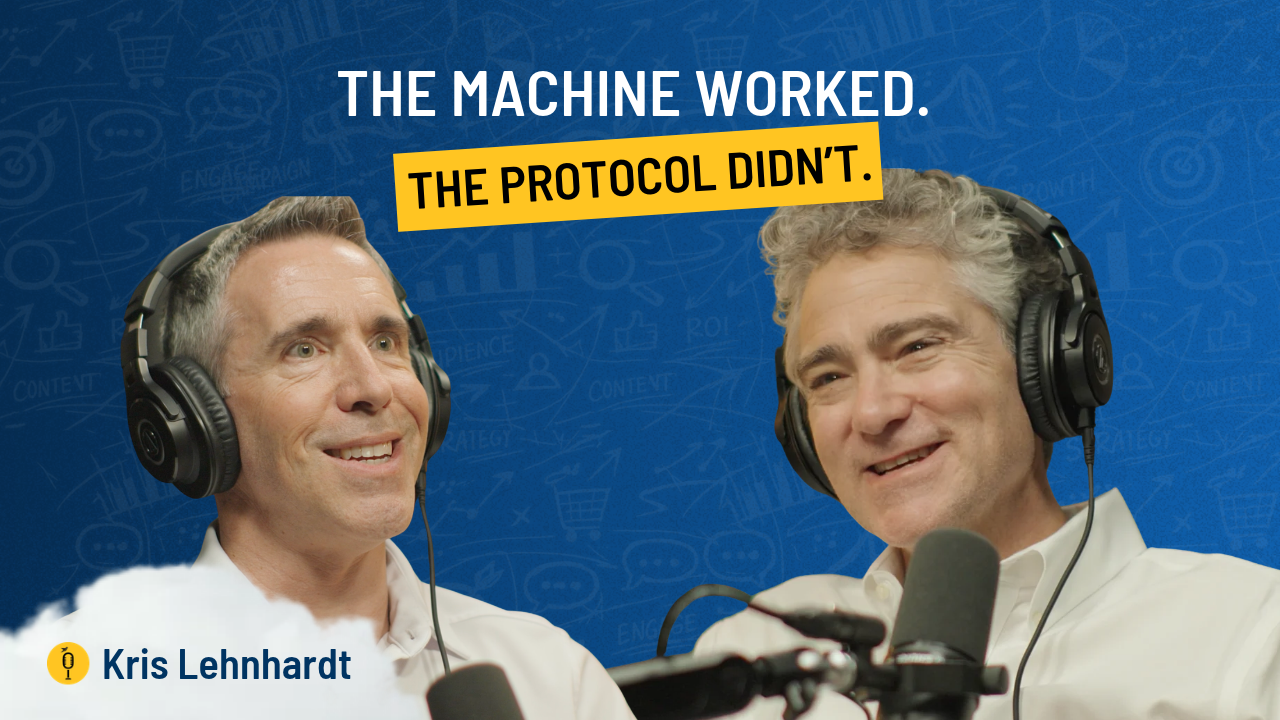
Dave Lynch is co-CEO of Vigilent, an Oakland-based company that uses AI to run data center cooling systems in 37 countries with less energy.
Dave and Richard dig into why data centers drift from their original design, how liquid cooling is reshaping the industry, the growing public conversation around data centers, and what’s real versus hype in the AI boom.
If you’re building, running, or just trying to understand the infrastructure behind AI, this one’s for you.
Richard Byrd
All right, welcome to the Above the Clouds podcast. We have a very special guest today, Dave Lynch with Vigilent. Welcome to the podcast, Dave.
Dave Lynch
Thank you, Richard. Thanks again for having me. I really appreciate it. Great to be here today, and I look forward to talking with you.
Richard Byrd
I'm really looking forward to talking to you, because your industry is the data center industry, and that's gotten a lot of headlines, especially with the midterms that just happened. You guys have been in the headlines all year long, and for the last couple of years, and now you're in the headlines for something else. So I can't wait to dig into that.
Dave Lynch
Sounds good.
Richard Byrd
Like I said, AI and data centers have been in the headlines for a while. Why don't you tell us a little bit about Vigilent, what you guys are up to, and how you're helping with the things going on inside those mysterious data centers.
Dave Lynch
Data centers are obviously a very hot subject. A lot of people are talking about the chips, the GPUs, the big build-outs. The reality is, every watt that goes into a chip is going to come out as heat. And somebody has to get rid of that heat, and do it reliably every second of every day. That's where we live.
Vigilent is an AI control layer for data center cooling. We use existing sensors, or we put in new ones right at the racks within the data center. Then our software learns how that specific facility behaves. If I turn this fan up here, or turn that cooling unit off over there, where do the temperatures go up? Where do they go down? What happens? Once it knows that, it runs the cooling system optimally in real time. It delivers cooling wherever the heat actually is and stops cooling the places that don't need it.
What that does is make operators a lot more efficient. It gives them resilience, because hot spots get caught and fixed before they turn into big problems, which could ultimately be an outage if things really go south.
It helps with cost. Facilities typically cut cooling energy by around a third, and in some very conservative sites, even more than that. We can talk about the benefits of that more in the podcast.
And third, and this is the big one right now, it's capacity. In this market, the scarcest thing isn't money. It's power. Every kilowatt we save on cooling is a kilowatt that can be repurposed. It can go back to compute, or you can just run fundamentally more efficiently. So we're really helping operators get more AI out of the same building and the same utility hookup. We're running in hundreds of data centers and telecom facilities around the world, directly and through partners, which we can talk about more as well.
Richard Byrd
Wow, that's quite a value proposition, especially in such a big and fast-moving industry. Time and energy seem like the limiting factors, so it definitely does seem like it's money.
One of the things you told me in our earlier discussions was that you guys were screaming from the mountaintop about data centers a long time ago, back in 2008, before a lot of people were really talking about that. Tell me a little bit about that.
Dave Lynch
Our founder, Dr. Cliff Federspiel, did his doctorate at MIT on the connection between machine learning and control engineering. He started this company in 2008, and from day one the pitch was, let AI control your cooling.
He actually started out in buildings that had people in them, bringing those buildings up to modern standards. But what they found in that market was that it was very fragmented and difficult to crack. There are a lot of players and a lot of individual decision makers, so it was very hard to get penetration. So they decided to focus on another space, and they started to see that data centers seemed like a good place to focus. They're mission-critical facilities, they consume a lot of cooling energy, and that ecosystem is a lot more manageable.
That said, when you go back to 2008, you have to picture who you're talking to. A data center facility manager has one job: never go down. Back in those days, they weren't rewarded for energy savings or running optimally or efficiently, and they would get fired if there was an outage. So we're coming in saying, hey, hand the controls over to an algorithm. And the response usually was, no way, we're not going to do that.
But even in a really conservative industry, there are always visionaries. There are folks who want a better way of doing things, who want to make a name for themselves within an organization and see this as an opportunity, or who just want to make a big impact for themselves and their company. Those are the folks our story resonated with.
What we learned is that you have to go in and prove the value. We would install, show them how it's running, and slowly they would gain confidence in the system. We'd turn it over to control, and they would really see the changes in their facilities and that the benefits were real.
There's one customer in particular, NTT, who's our distributor in Japan, who initially thought in one of their facilities that we were gaming the data. They saw the energy drop off and said, hey, you guys are gaming the data, what's going on here? And they came to realize, no, this is really optimally controlling our facility. It's working.
We've also had circumstances where we go in and the facility is usually super, super cold. We're able to raise that temperature up within safe operating levels that the operators can set, and by doing that, you run more efficiently and save a lot on cooling energy. We've had occasions where people come in and say, something's wrong, the temperature is too warm in the data center.
So it's taken a long time. We've been talking to people about AI and data centers for over 18 years, and I think it's finally starting to come full circle. We can talk about the advent of AI and the different flavors of it. It's definitely been a long road, and a fun and challenging one.
Richard Byrd
We see that across a lot of industries doing automation or autonomous systems. People don't want to give control over to the machines until they do, and then they're like, well, actually, that was pretty good.
I was giving an analogy to somebody the other day about laser eye surgery. When that was first invented, I was like, there's no way I'm letting a robotic arm shoot a laser beam into my eye. Give me the gray-haired surgeon with a lot of experience and a sharp knife. And now I'm like, there's no way. Keep that old man with his knife away from my eye.
Dave Lynch
Right. What was I thinking?
Richard Byrd
Another thing you mentioned that I thought was really interesting is that when things aren't automated, people tend to over-engineer them. They use a lot of rules of thumb. That helps with downtime and redundancy, the things people get fired for, but it's not the most efficient. A lot of times they don't know, because they just stick to those rules of thumb. But when they're able to really look at the data, it opens their minds up to new levels of efficiency they never would have recognized before, just out of fear.
Dave Lynch
Absolutely. And in a constrained world, those challenges become even more acute. Operators are now in a position where they have to flip the narrative and get the maximum contribution out of their facilities because of the constraints that exist. You're right, in an unconstrained world, people have a tendency to go with the status quo. If it works, it works. If it's not broken, why would I try to fix it?
Given some of the challenges we're having, and you talked a little about the election results, which we can get into too, people are having to change their approach and really figure out how to run facilities, particularly data centers in our world, much more efficiently and optimally. And the AI algorithms we provide can help them do that.
Richard Byrd
That's right. When there's a gold rush, people aren't worried about efficiency as much. Then something happens and they go, well, maybe we need to be more efficient and think this through. Not every river's loaded with gold like we thought it was.
Richard Byrd
You had a very circuitous route to get where you are today, and one of the things you talked about was starting at Dust Networks. Walk the audience through who you are and how you got here. I'm sure when you were in sixth grade you weren't thinking, I'm going to go run a data center cooling algorithm company.
Dave Lynch
No. In sixth grade, I didn't know what a data center was, for sure. It's been an interesting and fun ride.
I was previously at a company called Dust Networks. That came out of Kris Pister's Smart Dust research at UC Berkeley. The idea was to take these tiny, low-powered wireless sensors that could go anywhere and run on batteries for years, and build mesh networking technology around them. That became the basis for a bunch of industrial controls and wireless standards, one in particular called WirelessHART. So it ended up in refineries and pharmaceutical plants, sensing and measuring. Believe it or not, there was even a project to measure the Sierra snowpack with these wireless sensors. Super interesting technology, used in a lot of areas.
Vigilent was actually one of Dust's customers, and I was the CFO at Dust from 2003 to 2011. When you're the CFO, you get to see everybody's numbers. I could see how customers were using the product, what they were doing, and where they were deploying. Vigilent really stood out to me. This was a company that wasn't using our sensors to monitor things. They were using them to control things, closing the loop and making real decisions in real time. And the results weren't fuzzy. There was real value you could see in the utility bill. Real, hard-dollar ROI.
Dust was acquired by Linear Technology at the end of 2011, and eventually again by Analog Devices, so it's part of Analog Devices now. At the time of that transition, I started having conversations with Cliff and Elisa Federspiel, the Vigilent co-founding team. I'd been really excited by what they were building. Honestly, what brought me into Vigilent was that I'd seen the technology underneath and trusted it, and here was a team going after a problem I thought was only going to get bigger. By that time, I did know what data centers were, and I thought that was a really interesting place to point these solutions.
As a finance guy at heart, even though I'm now co-CEO, I like a business problem you can measure. Cooling energy is a hard-dollar line item that's very measurable. Stranded capacity is real money, and that problem has only gotten more acute with the constraints we talked about. Downtime is real money. Capacity is real money. This is a company where the value is measurable and it helps solve real problems, and I completely fell for that. The efficiency and sustainability angles are added benefits of what we bring to market. That's the long and short of how I got here.
Richard Byrd
They put you in that finance role, and that's what got you over. But you didn't stay there for long, did you?
Dave Lynch
That's right. I've worn a lot of hats here at Vigilent, and I've been fortunate. I started out as CFO and then moved into a couple of different roles: COO, managing operations, and chief revenue officer, overseeing sales. Seeing those disciplines and how they interact and roll together broadened my horizons. Ultimately, the board was kind enough to put me in the role of co-CEO, where I'm responsible for all those same functions, plus a lot of the strategic and directional orientation for the company. It's been an amazing and fun road to be on.
Richard Byrd
One of the things you talked about earlier, and we said let's come back to it, is the different flavors of AI. You had a really good quote on that. I actually quoted you the other day without you knowing about it. Walk us through that.
Dave Lynch
Wow, thank you. I appreciate it.
When a lot of people hear AI today, they're thinking about a chatbot, like ChatGPT writing a poem. That's generative AI, and it's obviously amazing, but fundamentally it's built to be creative. When you think about a data center and cooling control, the last thing you want is creativity.
We use a very different branch of AI that comes from control engineering. Our system combines three techniques that have been proven over time: supervised machine learning, model-based control, and something called extremum seeking, which keeps hunting for the most efficient operating point using real evidence and empirical data, not risky experimentation.
In plain English, it works like this. The system learns from real data exactly how each unit affects the others. We call that our influence map. It's a living model of cause and effect in the data center. It uses that model to predict what's going to happen before it acts. If I turn this up or down, or make this change, what's going to happen? Then it measures the result, learns from it, and keeps doing that over time.
Why that matters is that it's explainable. You can tell an operator, here's what it's doing and here's why. It's bounded, and it has guardrails. We talked about operators being risk averse. The great thing about our system is that operators can set the parameters, and it operates within those guardrails to make sure things are running as efficiently as possible. Anything unexplained, like a sensor dropping out or a unit failing, kicks it into a fail-safe mode.
So I'd put it this way. Generative AI is brilliant at writing and creativity. Our AI is brilliant at being boring. Not in a bad way, in a good way. It's boring in the sense that it's doing the right thing every few seconds, indefinitely, as long as it's running. It keeps the facility operating optimally, depending on the conditions and constraints. And unlike operators, it doesn't need to sleep. That's a big added benefit of AI solutions.
Richard Byrd
When you think about that continuous monitoring, and making continuous predictions and improvements, that's just something no human is good at. We like to sleep and eat, we get distracted, we're wondering what we're going to eat for lunch. AI doesn't do that. It's always making those predictions.
I also love what you said about not wanting your AI to be creative in this world.
Dave Lynch
No. Not in a data center.
Richard Byrd
It starts making stuff up, and you don't want delusions when that much is at stake in high-stakes environments like the ones you operate in. That's a great thing to think about.
Maybe that leads us into the other thing we wanted to talk about with AI and data centers. It's definitely top of the news, and with the midterms that just came through, it's a very interesting time. I saw a news report the other day that said a lot of states, even our super business-friendly Texas, are saying, hold on, let's put a moratorium on new data centers for now. Maybe they're thinking about putting up some red tape. How do you think that's going to affect your business?
Dave Lynch
It's super top of mind and super relevant to what's going on today. People are nervous about AI and data centers, especially the large ones, and there are real issues. They can raise electricity rates, they can affect local water supplies, and they can be noisy.
That said, data centers are core to our modern economy, so I certainly don't think any kind of blanket moratorium is a good idea. If you tell people they don't really need online banking, or that they don't really care about Netflix, they're going to have a problem. We absolutely need data centers. They're core to what we're doing technologically and societally.
I think what we really need is regulation that ensures data centers contribute more to communities than they take. An example might be a data center operator bringing along more electricity than they're using, ideally 100% renewable if that's possible. Systems should be designed to minimize water use to the extent they can. And there's some benefit in not putting data centers right next to communities, to avoid eyesores and noise, which is a huge issue from a community perspective.
As far as how that affects Vigilent, new regulations that promote sustainable operators really align with our technology and our core values. Our software is designed to dynamically minimize cooling power, which cuts electricity use, water consumption, and noise levels. Those efficiency improvements can help builders deliver the compute they need without needing as many data centers. If you think about the one-third savings we can deliver on average, you could build three data centers instead of four. That's a gigantic impact societally. So what we do can really help data centers meet the requirements communities are now demanding.
Again, I don't think a blanket moratorium is the answer. Building these facilities more sustainably and more thoughtfully is the approach we need to take. I'm hoping these regulations are more a mandate on that, as opposed to a blanket "we don't want data centers."
Richard Byrd
I think you nailed it. Everything in our society needs these data centers, and with the rise of AI and everything else, I can't imagine what would happen if we didn't embrace this. So we kind of have to. But it goes back to that not-in-my-backyard sentiment, where everybody's like, yes, I want my Netflix, but wait, I don't want this in my backyard.
It's like that with so many industries. Mining, for example. We know we need rare earths and copper and all these things, but nobody wants a copper mine in their backyard. So it's striking that balance, because we need it, but we also have to watch over people's needs.
I like what you said about making it more efficient so there's less energy demand. That's the kind of thinking that can make these more sustainable, and quieter. That's one of the big complaints you hear: they put this in my backyard, and now my dog is freaked out because of all the noise and the bright lights. Those things can be managed, and I do think governance is a good way to do that, as long as they get the balance right. Not a big clamp that says nothing gets built, and not "forget it, no rules, go crazy, guys." There's got to be something in the middle where we can all be happy.
Dave Lynch
I 100% agree, and hopefully that's the path we're going down. It was super interesting to see the categorical reaction in the midterms around data center initiatives. I think it was something like 37 out of 38, though I haven't dug into them yet. The message was, let's claw back a little bit. So let's go toward that middle ground, as you're saying, as opposed to one end of the spectrum or the other.
Richard Byrd
What was interesting too is that a lot of rural areas were the ones really pushing back on data centers, because they're the ones getting them in their backyard. You don't want to put one of these in the middle of Manhattan. And that's traditionally where Republicans have a stronghold. It was kind of Trump country, and now those folks were going, hey, wait a second, this is affecting me now. This isn't an issue I can't relate to. It's affecting my life, and I want us to slow down a little bit here. So it was a very interesting election, for sure.
Dave Lynch
Fundamentally, your point is let's be thoughtful about these types of decisions and what we're doing. Hopefully that's the direction we'll go.
Richard Byrd
We can all keep our fingers crossed for that.
One of the things you talked about earlier, and it goes back to why autonomy is so important, is that on day one of a data center, everything works great. But after that, it's a new day. Walk us through why that is. It's the same building, the same electronics. Maybe usage fluctuates, but why does it shift?
Dave Lynch
It's a great question. On commissioning day, when a data center goes live, everything matches the drawings and the specifications. The racks are where the engineers said they'd be, the loads are what they modeled, and the airflow is exactly how the simulations showed it. It's beautiful. The design matches reality.
Then the building opens and real life starts. Customers move in on their own schedules, not the design schedule. One hall or one building fills up, and the next one sits half empty. Someone installs a 40-kilowatt rack full of GPUs where they'd planned for only 10. Somebody pulls floor tiles to run a cable and doesn't put them back. A cooling unit gets serviced and comes back with a slightly different setting.
And you mentioned dynamism. Workloads shift every hour, and with AI, a training run can swing power dramatically in seconds. Then add seasonality: summer, winter, a heat wave comes in. There's a lot of dynamism in the data center. So within months, if not sooner, that perfectly designed building has drifted from its specification.
What operators typically do when they're nervous, like we talked about, is go conservative. They over-cool everything. They run every unit, turn set points down, and add redundancy on top of redundancy to make sure there are failovers. It feels safe as an operator, and we understand why people make those choices. But it wastes an absolutely huge amount of energy, it strands a ton of capacity, and it can still leave hidden hot spots, because the cold air may not be getting where it's supposed to go. So you're really not doing yourself a favor running that way.
That's the gap we close. A static design just can't keep up with a dynamic building. Our system continuously relearns and continuously optimizes the building, so you're running it on day 1,000 the same as you did on day one, if not better. But you have to leverage technology to do that.
And these environments are getting even more complicated, because we're starting to introduce new types of units, like coolant distribution units for GPUs. There's a lot more complexity and dynamism in these facilities than there was even a few years ago, which makes it even more challenging.
Richard Byrd
As fast as that technology is changing, whatever it is today is not going to be what it is a quarter from now, and certainly not a year from now. I've never seen an industry move that fast and change so fast. I was talking to a friend about it, and in my career, and I'm getting old now, I've seen so many trends come and go and different waves of technology come in. I've never seen one like this. It's a bigger wave, and it's moving a lot faster than any of the others.
Dave Lynch
Ditto. It kind of feels like a tsunami relative to the standard beach waves. It's pretty crazy.
Richard Byrd
It is a tsunami. I don't know how you get ahead of it. Like you said, you just have to adapt and have adaptive technology that can handle whatever's coming next.
When you talk about the different cooling, walk me through it. I'm not a technical person. How does cooling work in these places? You mentioned air units, and water, and liquid. Walk me through those variables and the channels that are used.
Dave Lynch
I'm not a technical guy either, but I know enough to be a little dangerous. That's the fun spot.
Think of it as three loops passing heat along, kind of like a bucket brigade. Loop one is the air loop. Big air handling units push cold air through the room, the servers pull it in, and the hot air goes back to be cooled again. That's how most data centers have worked for decades, and that's an area we've been optimizing since 2008.
Loop two is water. The air handlers dump that heat into chilled water, which goes out to a chiller plant and cooling towers, maybe on the roof or in the yard. That's where the heat is finally released outside. Those big chillers and that water loop are also super relevant.
Loop three is relatively new, and it goes back to the dynamism. This is liquid cooling straight to the chip. AI chips run so hot that traditional air cooling can't keep up. So you're basically bolting a cold plate right onto the GPU and pumping coolant through it, using devices called CDUs, or coolant distribution units. In the new AI data centers we see, 70 to 80% of the heat is going into that liquid. The other 20 to 30% is still air, cooling things like the networking, the storage, the power gear, and the parts of the server the liquid doesn't touch. But a lot of the cooling today is being done by those coolant distribution units.
What changes is that those loops used to be managed separately, by different teams and different control systems, but they're really tightly coupled. If you change the liquid temperature, for example, you change what the chiller plant has to do, and that changes what happens on the air side.
Nvidia is talking about efficiency by making chips that can run with warmer water. That'll help unlock capacity and run more efficiently, and it opens the door to a lot more free cooling. But it also means the margins are thinner, and everything's happening faster. So you really need control layers there to make sure things stay within parameters.
The fundamental point is that you can't optimize one loop and ignore the others. You have to run the whole system as one. That's exactly why we built our platform to cover the whole data hall, from the air side to the liquid side to the chiller plant, all together, so everything works in concert and the whole facility is as efficient as it can possibly be.
Richard Byrd
I can see where that orchestration could lead to some real efficiency gains. Is that kind of the secret behind why you're able to improve efficiency so much?
Dave Lynch
You get compounding effects. You can deploy these solutions independently, but as things continue to converge, you really want to look at the whole facility on a connected basis. You can get a lot of benefit just by looking at the air side. But when you add chiller and coolant distribution unit control, you're compounding your benefits. You're unlocking more capacity and running more efficiently. So you definitely get a compounding benefit the more you introduce the autonomous management layer.
Richard Byrd
I can imagine if you're only looking at one input at a time, you could have the air fighting the cooling and actually be counterproductive.
Dave Lynch
Absolutely. That's right.
Richard Byrd
That's pretty cool. Very interesting. I feel smarter today than I did before I called you.
Dave Lynch
Good. That's one of the goals of the program. And speaking of the technology, CDUs, man. A couple of years ago, you'd go to shows and maybe see a couple of them. Now that's all you see on an equipment show floor. That transition has happened very, very quickly. It's been amazing.
Richard Byrd
One of the things the industry gets penalized for is water usage. Not just electricity and sucking all the energy out of the grid, but water too. A lot of times, where they put these things, they want more jackrabbits and fewer humans, and those areas traditionally don't have a lot of water. So the people who live in that community are going, hey, what's going to happen? Now we're fighting over another scarce resource. What's your take on water usage in data centers?
Dave Lynch
It's actually complicated, and I want to be super careful here, because it's a real issue in some communities, as you pointed out. If you put a big evaporatively cooled campus in a water-stressed town, that's a legitimate local concern.
But nationally, I think the story is often framed wrong. There's a 2023 study by Lawrence Berkeley National Lab estimating how much water these facilities use, and they found it was about 17 billion gallons annually. That sounds like a gigantic number, and it is a big number, but it's under a tenth of a percent of what U.S. agriculture uses. So you have to keep the trade-offs of benefits versus impacts in mind.
The part nobody really talks about is that the water used to generate the electricity for those data centers was about 211 billion gallons. That's roughly 12 times the amount used on site. So the biggest water lever isn't really the cooling tower or the facility itself. It's the power bill. Every kilowatt-hour you don't waste is water you don't consume at a power plant somewhere.
You have to dig a little deeper. A billion gallons is a super scary headline number, and the narrative around it depends on cooling design, climate, grid mix, and withdrawal versus consumption. That's a story a lot of people aren't going to dig into. There's also not really a standard way to measure and report on this, so people fill the vacuum with their own narratives and their own numbers.
Coming back to us, I think the real, honest answer is that efficiency is going to be one of the most important solutions to the water issue. When we cut cooling energy, we're cutting water at the power plant. And when a site uses evaporative cooling, smarter control can help reduce the water use there too. That's a much better story than "data centers are draining the reservoir." Back to the balance issue: how do we figure out how to do this as efficiently as possible?
Richard Byrd
I like what you said there, because any time you're trying to improve efficiency, you go after the big buckets before the small buckets. Like you said, on-site water usage versus the power plants is widely out of balance. If you can reduce that by a third, all of a sudden you're talking serious savings.
Dave Lynch
Meaningful impact for the communities that have these facilities. That's right. And better benefits for operators, obviously.
Richard Byrd
An analogy to that: in a previous life, I was working for an oil and gas services company when fracking really took off, and they got a black eye for their water consumption. So we ran the numbers like you did, because we were a bunch of engineers and we're good at looking at numbers. And we said, do you know that the golf club right up the street uses twice as much water as we do? And people were like, no, we didn't know that, but we like golf and we don't like you.
Dave Lynch
Direct water use for all the data centers in the U.S., I think, is something like 4% of golf course use, order of magnitude.
Richard Byrd
They use so much water at golf courses. But I will say, I think responsible industries like the data center industry are going to step up too. The oil and gas industry said, you're right, we're going to do better. They figured out a lot of reuse, and now they're using a fraction of the water they used to. It was in their best interest. It wasn't only better for the environment and the community, it was better for their wallet, to be able to reuse this water, strip out the bad stuff, and keep the good stuff.
Dave Lynch
Ultimately, efficiency and sustainability are truly win-wins for everybody: society and companies. That's truly what we believe.
Richard Byrd
It's truly two sides of the same coin. If you've improved your efficiency, you're going to improve your sustainability. I wanted to see if I could break that, but I couldn't.
We've talked about how fast this industry is changing and scaling up. They call the people doing it hyperscalers. When things scale up that fast, people tend to think it's a bubble. You already talked about how fundamental this is to so many parts of society and technology, but walk me through your thoughts on the data center bubble, or the AI bubble.
Dave Lynch
If you've seen some bubbles before, and I've seen a couple, the dot-com bubble and the financial crisis to name a few, you start to see some trends. One of my takeaways is that infrastructure usually outlasts hype. People tend to overstate the near-term impact of large, fundamental changes and understate the long-term impact. In 2001, for example, a lot of companies went bust, but the fiber in the ground still got used, and it became the backbone of a lot of what came afterward.
I think something similar is happening now. What's real: demand for compute is real. The physics is real. Chips use more power and throw off more heat with every generation, and like you said, it's changing very rapidly. Power is the bottleneck in almost every major market. None of that goes away if a few AI companies stumble.
What's hype is the assumption that every announced gigawatt is going to be built on schedule, or even built at all in some cases, given some of the measures that recently passed. Or that every project is funded with a tenant, or that every company with AI in its pitch deck has a business. Those are the hype cycles, and I think there'll be a shakeout. Some projects will get delayed or even canceled, and some valuations will look silly in hindsight.
But for us, and for operators, the point is that whether we're in a boom or a correction, efficiency wins. In a boom, efficiency gets you more capacity out of scarce power, so you can do more using less. In a downturn, efficiency protects your margins. The tools that make existing infrastructure work harder are the ones that hold up in both markets. That's a pretty comfortable place to be. We don't need the hype to be right. We just need the heat to continue to be an issue in data centers, and we're very confident that's going to continue to be a challenge people need to address.
Richard Byrd
I think that is an inescapable challenge. We had a guest on the podcast a few episodes ago, Rama Afullo, who was talking about data centers in space and putting compute power in space. I thought that was wild, and a big part of it was getting away from the heat. Also, you're not putting it in anybody's backyard. Except you're putting it in everybody's backyard, because they can see it from their backyard.
It's really interesting, the lengths people will go to avoid that. He even said people think it's cold in space, but it's not. Heat is just different there than it is on Earth. So it's still a problem in space, and it's still a problem on Earth. People are trying everything to get around it. But you guys have an interesting solution, because you're taking the existing systems people have and making them work better together, instead of trying to take the whole thing and put it in space, which seems a little more challenging.
Dave Lynch
One step at a time, we can solve many different problems. If we could fundamentally have all the data centers that are built or being built run as optimally and efficiently as they could, that would be a huge win, before we even go into space.
Richard Byrd
Let's solve some terrestrial challenges before we move it to space.
This is a sales and marketing podcast, after all, so maybe we could talk a little about how you go to market. One of the things you mentioned to me is that a big part of your scale and growth has come from working through partners. Talk to me about that approach and why you chose that route.
Dave Lynch
That fundamentally came from being honest about who we are. We're a focused software company headquartered in Oakland, California. Our customers are some of the biggest organizations in the world, and they're on almost every continent except Antarctica. That's one place we don't have any deployments. We were never going to out-hire somebody like Schneider Electric or Siemens, who are two of our partners, for boots on the ground, or even try to.
So we partnered with companies that have trust and reach in our ecosystem. Siemens is a great example. Our technology is core to what they call their white space cooling optimization offering, and their venture arm is an investor. I mentioned NTT earlier; they're a strategic partner and an investor in Japan. Schneider Electric takes us to market as what they call cooling optimized in their ecosystem software family.
What did going to partners give us? Three things. First, reach. We can be in markets where we'll never have an office. We've got deployments in 37 countries, and there's absolutely no way we could have had the resources to deploy in those 37 countries without the help of partners.
Second, trust. Going back to those initial discussions, a facility manager is going to trust Schneider or Siemens when they come with a solution, because they've been working with them for 20 years and know they'll bring something that's vetted and works. It's a much harder conversation if you're doing it directly.
And lastly, leverage. The partners help with installation and service, and we get to focus on making the AI better.
So that's why we chose the partner model. And for any B2B company that's listening: if your product is better than your distribution, partners aren't a compromise. They're a growth strategy. That's ultimately why we moved in that direction.
Richard Byrd
I think that's something where you can really see small companies scale fast using that model. The tricky part is you have to treat partners like they're the end customers sometimes, so they know the new cool things you're doing and can communicate them to their customers. It sounds easy, because you're talking to smart people. These guys are smart engineers, we'll just send the email and I'm sure they'll communicate it perfectly. It has different challenges, and there's no silver bullet. But we've seen with a lot of our clients that just because a distributor said they'll bring you into their clients doesn't mean you can set it and forget it.
Dave Lynch
Absolutely. And while we've leveraged the partner model, we still keep direct customers as well, because we want that pulse of the customer. We want to keep hearing that feedback directly and make sure we've got that narrative, so we can incorporate it and bring it to our partners to help them leverage it even more fully. But you're absolutely right.
Richard Byrd
There's something about hearing from the customer firsthand and working with them to solve things, especially in this dynamic environment. We beat that dead horse to death, talking about dynamic markets. But hearing from them and doing those installs yourself, there's just no substitute for that.
To me, that's a really interesting mix, being able to work directly and through those distributors. Because one of the things somebody warned me about in business, and I thought, I'm not worried about that, is revenue density. You're a finance guy, so you're probably rolling your eyes at me. But as a non-finance guy, I was like, I want that revenue. I don't care if it's dense or not dense, just bring the revenue. Let's go. But whenever one of those big, overly dense revenue chunks goes away, it is so painful. I didn't have any gray hair before that happened to me. I wouldn't wish that on my worst enemy.
Dave Lynch
Painful. Agreed.
Richard Byrd
All right. You walked us through how you came into the co-CEO seat, and it's been a really interesting route. You find yourself in that role at what must be the busiest time in the company's history. When times are good, there's one set of challenges, and when times are bad, there's another. How are you seeing it?
Dave Lynch
It's definitely a super busy time, with a lot of challenges. The thing I've found harder than expected is just saying no. When the whole market's on fire, every opportunity looks great and urgent. Every big bid, every partner, and every new region looks like the one you can't miss. A lot of my job now is choosing what we won't do, so the team can focus on the things we do really well.
As a CFO, you're thinking about allocating capital. As a CEO, you realize, if you didn't earlier, that the scarcest resource is the team's focus. So some of the toughest no's are about where and when to put resources. That's the constraint challenge again. Everybody's got them.
The other hard part, like you're saying, is just speed. The technology is changing under us super fast. Liquid cooling and CDUs went from niche to standard in about two years. In our industry, that's lightning speed, because things had been very static for quite a long time. And chip power keeps climbing every generation. So we have to build for where the market is going to be in 12 to 18 months, not where it is now, while continuing to serve the customers and partners running today's facilities.
On the positive side, what's surprised me is how much the market is starting to turn in our favor. We talked at the outset about screaming AI in this industry since 2008. For years, we had to explain why anyone would want AI to help with their cooling. Now customers are reaching out saying, hey, we think we need help with these challenges. What do you have to bring to bear? After a lot of years of pushing uphill, that obviously feels pretty good.
The second thing is the people. Our team has been phenomenal and super resilient. In a market like this, moving fast, people have options. The people who stay are the ones who believe in what we're building and love what we're doing. Despite these crazy timelines and schedules, our team continues to push forward and step up where they can add the most value. That's the thing that matters to me the most, more than any contract we've been able to win.
Richard Byrd
You understand your role. As CEO, you have to set that culture and hold people accountable to it, and there's no test of your culture like high growth.
I told my wife that owning this business is probably the most challenging job I've ever had. And she said, why do you say that? You've had big jobs at big companies. You just have this small company. What's so hard about it?
Dave Lynch
It's mine.
Richard Byrd
And I said, because it's always hard. When times are tough, it's hard. When times are great, it's hard. When you're growing, it's tough. As a leader, you see the things that are broken in the business, and you're like, we've got to fix that, we've got to fix that, and you've got more things to fix than you have time to fix them. That's where having a strong team really helps, and it's a true sign of their character when they stick with you through all those challenges of growth. Growing pains are pains nonetheless.
Dave Lynch
Good pain.
Richard Byrd
People say it's a good problem. Well, there's no such thing as a good problem. They're all problems.
Dave Lynch
We like to call them challenges. Let's overcome them.
Richard Byrd
I love it. You touched on it just there, and I'd like to follow up a little. Your job now is predicting and building for what's 18 months down the road. In an industry that's this noisy, how do you separate the signal from the noise? Because I can tell you, my crystal ball has been broken since about 2019. I used to feel like I could predict things pretty well, and since then, I feel like I can't predict anything anymore.
Dave Lynch
You really just have to keep talking to customers and partners, and listen and watch what's going on. For us, trying to identify the constraints in a market is really important, and those shift over time. When we started back in 2008, power wasn't really a constraint. Now it's a huge constraint, so our narrative has been changing over time.
This ties into your book, actually. You can have great technology, but if it's not positioned well, not marketed well, and not resonating, nobody's going to care.
So we try to understand where those constraints are going to be. I mentioned that the challenge of heat isn't going away, and neither is the dynamism in the market. As we look out over 18 months, we believe those challenges are only going to become more acute. So it's about making sure what we're building, and the platform we're architecting, is in a position to address those challenges for our customers and partners. That's where we spend our time when we look at the build.
And some of the constraints we've talked about today are still going to be with us, and even more acute. Power, for example, is not going away. Water, the efficiency requirements, the dynamic nature of these facilities, and the interoperation of these multiple systems are all going to become more and more acute. Making sure we're building to intercept and address those challenges is how we look at the next 12 to 18 months.
Richard Byrd
I like that vision. It's very practical. But let's get in our time machines and go out five years from now. Where do you see Vigilent? What are you doing, and what does the company look like?
Dave Lynch
That's a long horizon, so I'll put on my optimism cap and frame it this way: if Vigilent or similar technology is adopted, what happens? What does it mean?
Five years out, if we've done a good job and we're winning, a data center basically runs itself thermally. Every loop I talked about, from the chip to the liquid, to the air, to the chiller plant, to the cooling towers, is managed by a single system, by AI tools that know that specific facility better than anyone. Operators aren't chasing alarms at three in the morning. They're setting goals and making decisions, doing value-added activities instead of what we sometimes call playing whack-a-mole in a data center, trying to find the issue.
Cooling stops being a fixed overhead that you overbuild just in case. It becomes a dynamic resource that follows the workloads minute by minute. Our vision is transforming what the industry has historically called resilience by design, designing in over-capacity and redundancy on top of redundancy to make things safe, into what we call resilience through automation. Hopefully, in five years, that's a reality, and these tools and this technology are managing these facilities.
What would that mean for people? A lot more compute out of the same power. That's the big one. I talked about power and the grid being the constraint. We just can't build power plants and transmission lines fast enough. If every data center in the world ran its cooling as efficiently as the best ones do today, you would free up a huge amount of power and reduce carbon emissions and water use at the same time. We've estimated that AI-optimized cooling, deployed globally, could cut hundreds of millions of tons of carbon emissions a year. Data centers would also be less noisy, because reducing cooling and lowering strain on the mechanical systems cuts down on vibration and noise.
So for regular people, five years forward, that means AI that's cheaper to run, data centers that are better neighbors, which is a theme you've talked a lot about on this podcast, and less pressure on the grid that's powering their homes.
And in my ideal world, what does that mean for Vigilent five years from now? We'd love to be the standard in every facility. The thing nobody's talking about, that just does the same thing every day. Back to that boring AI analogy: it just keeps humming along and keeps the data center running as well over the next five years as it does today.
Richard Byrd
That's quite a vision.
Dave Lynch
We like to dream big.
Richard Byrd
But I think it's based on fundamentals, like you said. All these resources aren't going away. Water and electricity are intertwined. If you can improve that efficiency level, it's going to be better for everybody. It's going to make data centers better neighbors, it's going to make them more profitable, and hopefully it'll make you guys more profitable as well.
Dave Lynch
That'd be great. A win-win. We like win-wins.
Richard Byrd
I love it, Dave. Thank you so much for your time today. I know a lot more about the mysterious world of data centers after talking to you, what's going on in there and what's making these things so challenging. I'm really impressed with your offering and what you're bringing to the market. Thanks for being on the show.
Dave Lynch
Thank you, Richard. Thanks for having me. It was a blast. You get a lot of great people on the show and talk about a lot of cool topics, so I appreciate you having us on to talk a little about data centers today. We love to talk about them. It's a super interesting, dynamic space, with a lot going on nationally and globally. So thank you again for having us. Really appreciate it.
Richard Byrd
Sure. And if anybody wants to find out more about Vigilent, or get in contact with you, Dave, where should they go?
Dave Lynch
Thank you, Richard. You can start at vigilent.com. That's V-I-G-I-L-E-N-T, with an E-N-T at the end, not an A-N-T. That's on us; a lot of people get that wrong. You can find me on LinkedIn, Dave Lynch at Vigilent, or email dlynch@vigilent.com. If anybody out there listening runs a data center or is building one and wants to see what the building is actually doing, and what it can do with automation, we'd love to show you. And anyone who enjoyed this podcast, subscribe to Above the Clouds. You get some really cool guests and topics on here. Like and subscribe.
Richard Byrd
Cool. Thanks for the plug for us. All right, thanks again, Dave. Best of luck, and I hope you reach that vision in the next five years, because it sounds good for everybody.
Dave Lynch
Thank you, Richard. Appreciate it. Take care.
Let's get your wings ready!